Is Arcadia a Scam?

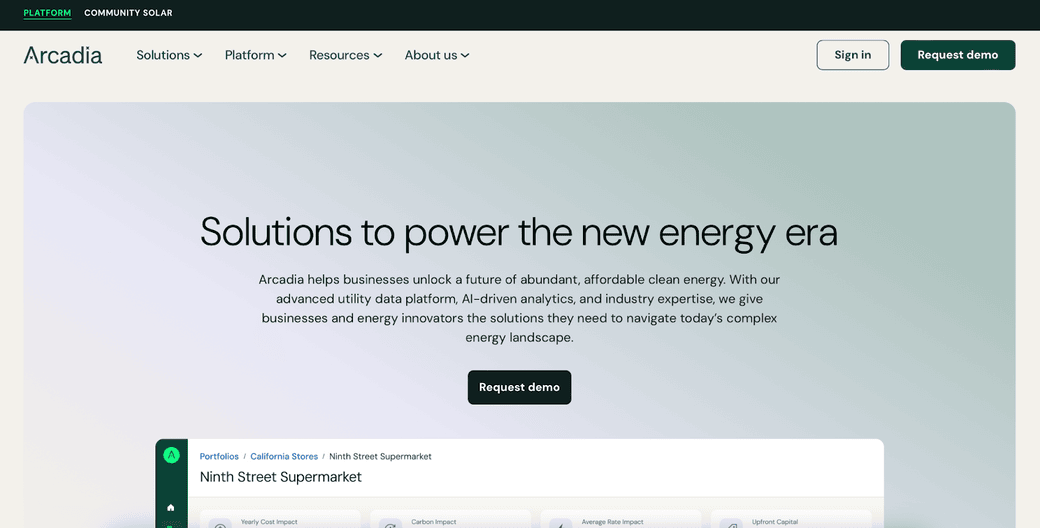
Table of Contents
If you’re thinking of signing up for Arcadia, you need to know whether it’s safe. Is Arcadia a scam?
Below, we explain whether Arcadia is a scam and discuss some steps you can take to improve your safety when signing up to this clean energy company.
What Is Arcadia?
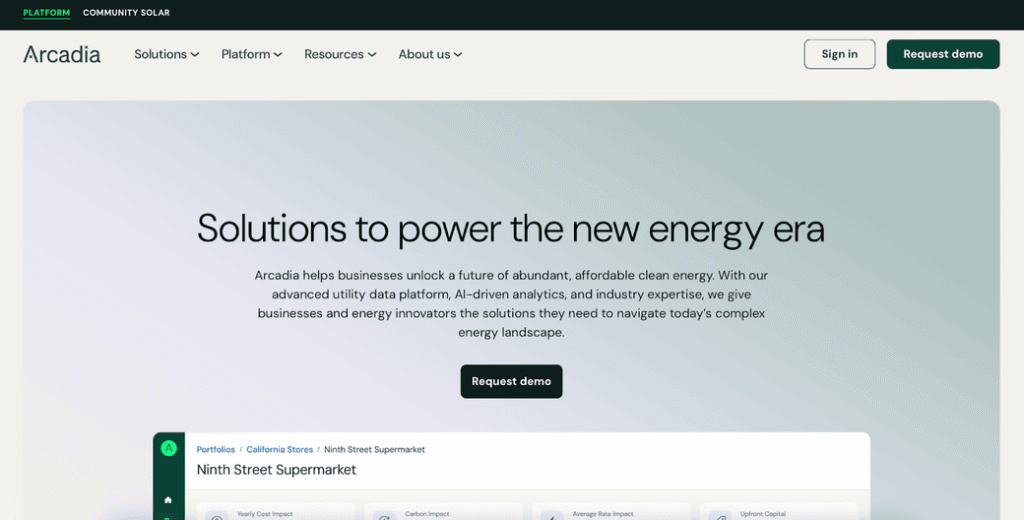
Arcadia is a company that helps people and businesses use clean energy.
With Arcadia, people can get connected to solar energy without having to install solar panels on their roof. Arcadia has a blog post explaining how community solar billing works.
Subscribers usually get two bills each month, one from their utility (which includes a credit line item) and one from the community solar provider. Arcadia has a blog post explaining how dual billing works.
At the time of writing, Arcadia has solar capacity in 16 US states, though whether you specifically can avail of solar capacity depends on your particular utility territory and ZIP code (which can sometimes lead to long wait times).
Separately, the company also operates a technology platform that collects and organizes energy and utility usage data from power companies all over the world and then provides this data through APIs, so businesses can monitor their energy costs, figure out ways to spend less money, and get data for sustainability reporting.
Arcadia was founded in 2014.
Is Arcadia a Scam?
Arcadia is a real company based in Washington, DC, that acts as a middleman connecting customers to community solar farms.
It’s been featured in third-party publications like CNET, but it appears to have a poor reputation with customers.
User reviews of Arcadia are mixed as of this writing and lean mostly negative.
- 2.5 out of 5.0 stars (from over 1,100 reviews) on Trustpilot.
- 1.22 out of 5.0 stars (from over 100 reviews) on Better Business Bureau.
- 1.9 out of 5.0 stars (from over 70 reviews) on Yelp.
The few positive reviews say that Arcadia helped them save money.
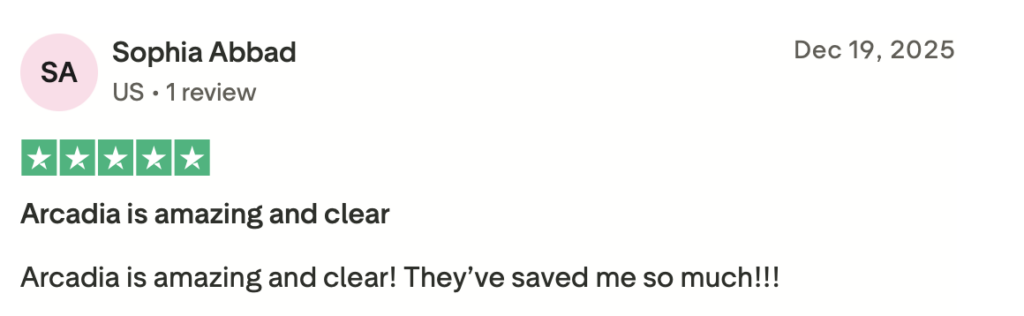
Negative reviews allege inexplicably high bills (with no monthly statement), a long cancellation process, and poor customer service.
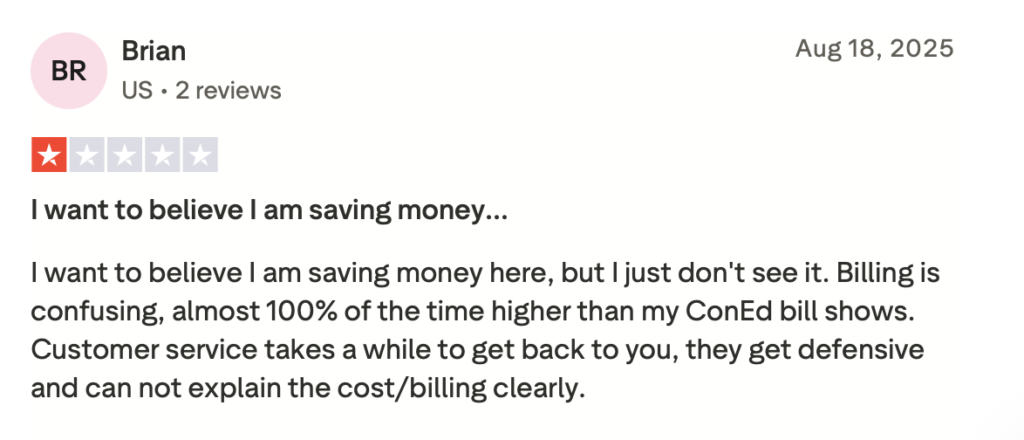
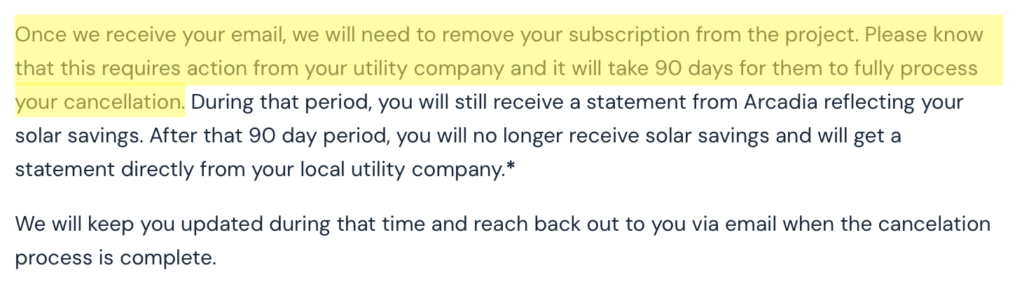
Arcadia addresses the 90-day cancellation process in its support center. It says that when they get your cancellation request, they need to remove you from the project, which requires action from your utility company and takes 90 days.
Many people also complain about Arcadia’s aggressive door-to-door sales.
On online forums like Reddit, people report varying experiences with Arcadia.
A minority of people say they’ve seen some savings after signing up with Arcadia.
One person writes:
“Took me like 18 months to finally get placed and farm up and running, but it does seem like I’m getting a 10% discount and my electricity supplier is now solar and (mostly) not cmp.”

Others say the company seems to have changed for the worse, with one person recounting how their rates doubled with no warning.
Another says Arcadia used to offer several energy management features (e.g., automatically finding the cheapest electric supplier) but switched to being purely a community solar company. After waiting on a community solar waitlist for 3 years, only to be told it would take another 6 years to actually get placed, they canceled and switched to another company.

Arcadia is a Better Business Bureau-accredited business and holds an “A” rating as of this writing. BBB ratings are a reflection of how the BBB thinks a company interacts with its customers.
At the time of writing, Arcadia has received a total of 130 complaints in the last three years, 36 of which have been closed in the past 12 months.
Complaints center around billing that’s confusing, sales practices that feel deceptive, a cancellation process that’s difficult, and customer service that’s unhelpful. Several people allege that their energy bills actually went up rather than down after joining Arcadia.
Arcadia security
In its privacy policy, Arcadia briefly describes its security measures.
It states that it takes “reasonable technical, administrative, and physical safeguards” to protect users’ personal data.

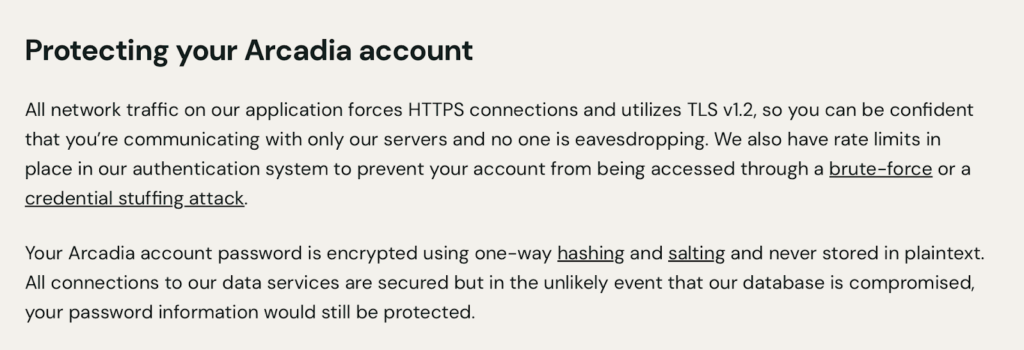
In a separate ‘Security’ section of its website, Arcadia adds that it enforces HTTPS with TLS 1.2 so that no one “eavesdrops” on your communications with the platform, has rate limits to stop your account from being accessed through credential stuffing or brute-force attacks, and encrypts your account information and passwords.
It also notes that your payment data is handled by Stripe and Plaid and that this data is not stored on Arcadia’s own systems.
The company’s AWS infrastructure complies with standards like ISO 27001, SOC 2, and PCI Level 1, and it actively patches vulnerabilities.
Arcadia privacy
Arcadia explains in its privacy policy the kind of data it collects, why, and with whom it shares it.
It states that it may collect the following information:
- Personal identifiers (name, address, email, phone).
- Third-party service account data (utility account info, usage/billing).
- Payment and transaction data.
- Internet/network activity (browsing history, cookies, clickstream).
- Marketing and research information.
- Audiovisual materials.
- Geolocation data.
- Home details (ownership status, dwelling type, appliances).
- Energy usage information.
For employees and job candidates, the company may also collect employment history, education, and sensitive data like health information and diversity information, as well as background check results.
Arcadia says it collects this data for commercial purposes (such as marketing, advertising, energy services, customer communication, analytics, and research) and business purposes (like service delivery, auditing, quality control, credit scoring, legal compliance, and security).
It says that it may share your information with service providers, affiliates, business partners, advertising and marketing partners, energy and utility companies, credit reporting agencies, financial service entities, analytics firms, government agencies, and law enforcement.
The company notes that mobile information and text messaging opt-in data are not shared for marketing purposes.
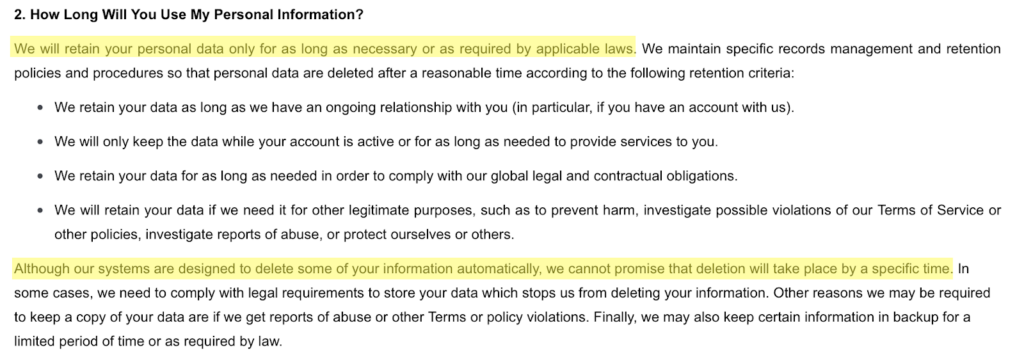
Arcadia keeps your data for as long as your relationship with them is active, for as long as needed to provide services, and as required by legal/contractual obligations. It notes that it can’t guarantee specific deletion timelines.
It says that it may transfer your data to countries outside your residence.
Users have specific privacy rights. For example, you can turn off cookies, control push notifications, and opt out of commercial emails, calls, and texts.
For those who live in states with privacy laws, there are additional rights, like the right to access, delete, correct, and opt out of targeted advertising.
Arcadia states that it does not sell personal information but that it may “share” it with third parties for marketing. You can opt out of that sharing.
The company does not respond to Do Not Track signals.
It says that it does not use automated decision-making that legally affects you.
So, Should You Use Arcadia?
Depends.
Arcadia may be a good option for individuals who want to support renewable energy, are comfortable with periodically monitoring their bills, and are okay with data sharing.
It may not be the best choice for people looking for predictable billing and guaranteed savings or those who want minimal data sharing. The allegedly difficult cancellation process may be something to think about, as well.
How to Use Arcadia Safely and Privately
- Read the contract (and cancellation terms) carefully. This helps you avoid surprises like long cancellation periods or unclear charges.
- Keep an eye on your energy bills. Compare your utility bills before and after joining Arcadia to detect unexpected increases or any discrepancies.
- Keep copies of statements and communications. Save invoices, emails, and chat transcripts so you have proof in case there are any billing disputes or in the event of cancellation issues.
- Check waitlist and placement timelines. Ask Arcadia for realistic timelines for community solar placement to avoid long waits that may delay benefits (as reported by some reviewers).
- Don’t give out any optional information. Only share necessary information to avoid additional details from being used for marketing or analytics.
- Protect your Arcadia account. Use a strong password and keep it safe (don’t reuse it elsewhere on the web).
- Opt out of Arcadia’s marketing. You can unsubscribe from promotional emails, calls, and texts, which reduces targeted advertising and data sharing for marketing purposes.
- Don’t accept or turn off cookies where possible. This limits the tracking of your browsing behavior and online activity.
- Turn off push notifications in the Arcadia mobile app. This minimizes the collection of your data that relates to your engagement and usage patterns.
- Don’t take surveys (or at least don’t overshare if you do take them). Your responses may be used for profiling and analytics.
- Don’t use social sharing features. This reduces the amount of data that flows to third-party platforms.
- Use your privacy rights. Depending on where you live, you may be able to request data access, correction, or deletion.
- Don’t share sensitive information if you don’t need to. For example, don’t turn on optional features like biometric login or provide sensitive details unless you are comfortable with how they may be processed.

news?

Don’t have the time?
DeleteMe is our premium privacy service that removes you from more than 750 data brokers like Whitepages, Spokeo, BeenVerified, plus many more.
Save 10% on DeleteMe when you use the code BLOG10.
Related Posts

Is Clawee a Scam?