The Reauthorization of FISA Section 702: The End of the Constitution Had to Start Somewhere

No matter what happens when Congress votes on reauthorizing FISA and Section 702, privacy is in desperate need of serious legislative attention, because as things stand, the U.S. Constitution, no matter which side of the political demarcations lines you stand, is in serious peril.
The Foreign Intelligence Surveillance Act and Section 702 has become a slippery slope that gives the government authority to collect your communications without a warrant. The 4th Amendment protects that. Or it used to.
The reauthorization of FISA Section 702 is one of the most consequential votes on American privacy in a generation–possibly ever.
Most Americans probably manage to live fairly satisfying lives without ever having heard of Section 702. Once they do hear about it, that’s less the case. By the end of this post, you will understand why that ignorance is not accidental. It was carefully designed. The reauthorization of FISA Section 702 may be the most important piece of legislation affecting your daily life, and since you will never see it debated on the evening news, welcome to the Fifth Estate where we talk about stuff that actually matters.
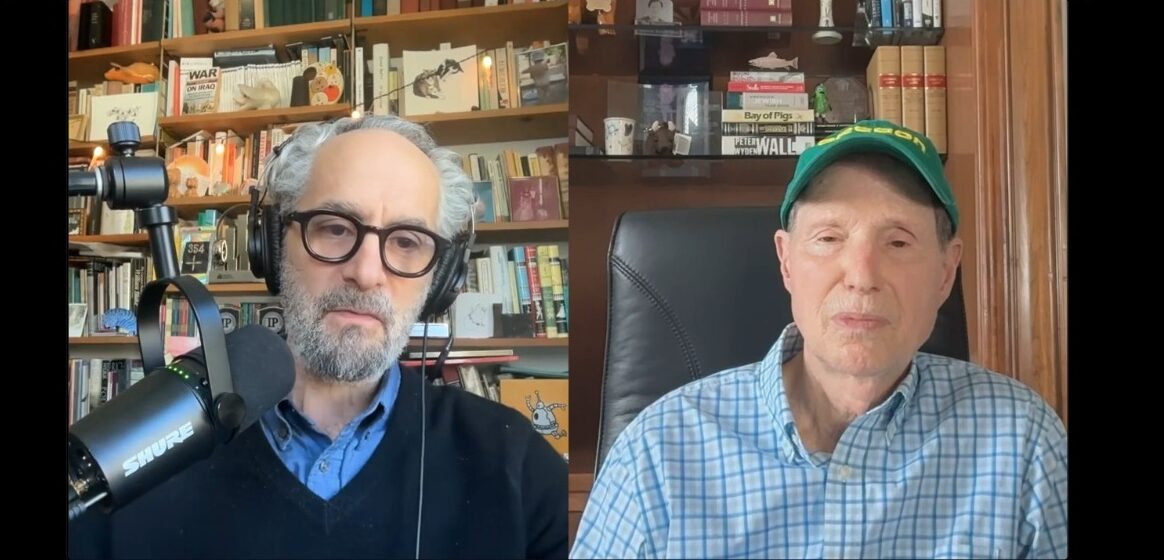
I spent the weekend recording an episode of What the Hack? because I couldn’t stop thinking about what’s at stake in the FISA Section 702 reauthorization debate.
Luckily had great company in the person of Senator Ron Wyden, the longest-serving member of the Senate Intelligence Committee. I also talked to Kia Hamadanchy, Senior Policy Counsel at the ACLU’s National Political Advocacy Division. And I talked to Marcy Wheeler, who has been covering national security and surveillance longer and more rigorously than almost anyone working today.
Okay, ready for a scary story?
Here is what Section 702 actually does
FISA was created in 1978 in the aftermath of Watergate. After disgraced President Richard Nixon used the intelligence community to spy on his political enemies, Congress created the law to limit government surveillance.
The idea was simple: if the government wants to spy on someone, they have to go to a special court and make their case. That court is called the Foreign Intelligence Surveillance Court, the FISC, and it was designed to be the check on executive power that Nixon proved we needed.
Section 702 of FISA was added in 2008 in response to 9-11, about the same interval of time that had passed between Watergate and FISA. There was a real problem. It was nothing the 4th Amendment could have foreseen; terrorists and foreign adversaries using American email servers, American phone networks, American internet infrastructure. Under the old rules, which were written during the age of wire taps, the government had to get an individual court order for every foreign target using those systems. It was slow and resource intensive. Section 702 gave the government a recurring, if reauthorized, annual blanket permission slip to surveil foreign targets overseas using American communications infrastructure. Foreign targets. Overseas. That was the deal.
The problem is what happened next
When an American communicates with someone overseas their communications get swept up too. That goes for journalists, a business contacts, family members, colleagues. Incidental collection is what George Orwell called Newspeak.
Because of the way some members work in the intelligence community, particularly the FBI, which does intel and law enforcement, our communications are in a database the FBI can search without a warrant.
It’s called a database query among proponents of Section 702. Civil liberties lawyers call it a warrantless search. The Fourth Amendment calls it a search, too. The government disagrees, and because the court that oversees FISA Section 702 is secret, their disagreement has never been properly tested in open court.
Nice.
This is what Senator Ron Wyden (D-OR) calls the backdoor search loophole. It has already been used to search for Black Lives Matter protesters and political campaign donors. Under Donald Trump, Wyden told me, it has grown. The only issue is we don’t know how much.
The DOJ says they’ve fixed the problem. The ruling is classified. Wyden wrote a letter about it that is sitting in a SCIF in Washington DC right now. Lawmakers can go read it. You cannot. Wyden told me on tape that what is in that document will stagger people when they find out. Congress is being asked to vote on the reauthorization of FISA Section 702 without that information being made public.
Time to invest in melatonin and magnesium, because no one who cares about their privacy is sleeping in America.
And then there is the data broker loophole
Another unforeseen depredation of the 4th Amendment comes by data brokers. Turns out, the government doesn’t always need to use Section 702 to get your data. It can just buy it. ICE, CBP, and other federal agencies have purchased location data, communication data, and behavioral data from commercial brokers to find people to deport. It’s data they would otherwise need a warrant to get. So here we are, commercialized disappearance of whatever minimization procedures exist in FISC. No court oversight. If you have a credit card, as Wyden put it, you can get around the Fourth Amendment.
This is not a hypothetical. ICE is using purchased location data to make arrests right now. And as Marcy Wheeler pointed out to me, the people being arrested this way have almost no ability to challenge how they were found. They are not criminal defendants. They do not get discovery. Their attorneys cannot challenge the surveillance because they can’t prove it happened.
Not thinking right about artificial intelligence
The ACLU’s Kia Hamadanchy told me that applying large language models to these massive datasets, which already contain enormous quantities of American communications data collected under FISA Section 702, is dangerous.
We have no idea what these systems are doing, what inferences they are drawing from and no insight regarding outcomes we cannot anticipate or understand.
Senator Wyden made the same point: AI-driven surveillance makes it possible to take scattered data and construct a comprehensive picture of anyone’s personal life, automatically, at massive scale. The Anthropic CEO Dario Amodei has said publicly that AI mass surveillance poses a serious and novel risk to fundamental liberties. We are not talking about a future risk. It’s happening now, with tools that are being applied to data collected under an authority that Congress is about to rubber stamp for another several years without putting the brakes on how AI might use it.
Here is what actual reform of FISA Section 702 would look like
Here’s a good start: A warrant requirement before the FBI can search 702 databases for information about Americans. Second, we need to close the data broker loophole so that law enforcement cannot purchase what they would otherwise need a warrant to collect.
From there, Marcy Wheeler pointed to what needs to happen; rebuilding the wall between intelligence and law enforcement inside the FBI. And although it may be a bridge too far, Marcy Wheeler is right that the government should have to disclose to criminal defendants when 702-collected information is being used against them.
The legislation being offered right now in the FISA Section 702 reauthorization debate does not include a warrant requirement, which is why Senator Wyden calls it fake reform and Kia Hamadanchy calls it a rubber stamp. A handful of House Republicans have shown the spine to hold the line so far. Whether they make it to the finish line matters less than this: Letting this moment realign the way we talk about privacy in America.
Kia Hamadanchy said something to me at the end of our conversation that I have not been able to stop thinking about.
“So tomorrow, if this program didn’t exist,” he said, “and…you heard tomorrow that Donald Trump wants the authority to collect communications, a lot of them from Americans…and then he’s gonna be able to go through those communications and search them without a warrant…no one in their right mind would vote to do that.”
Privacy win or loss, this fight is not over. If Congress passes a clean reauthorization of FISA Section 702 without meaningful reforms, the situation does not stay the same. It gets worse. The surveillance expands with more powerful AI tools. The data broker market will be rewarded for creating a Constitutional workaround, and the classified legal opinions pile up in skiffs that the public will never be allowed to read.
Call your representative today. Call them tonight. Call them tomorrow morning before the vote. And then keep calling after the vote, because the fight over FISA Section 702 does not end on April 30th.

news?

Don’t have the time?
DeleteMe is our premium privacy service that removes you from more than 750 data brokers like Whitepages, Spokeo, BeenVerified, plus many more.
Save 10% on DeleteMe when you use the code BLOG10.
Related Posts
California’s DROP Is Live: What It Does, What It Doesn’t, and How to Use It

Why Doesn’t Gen Z Care About Privacy?