Is Fetcharate a Scam?

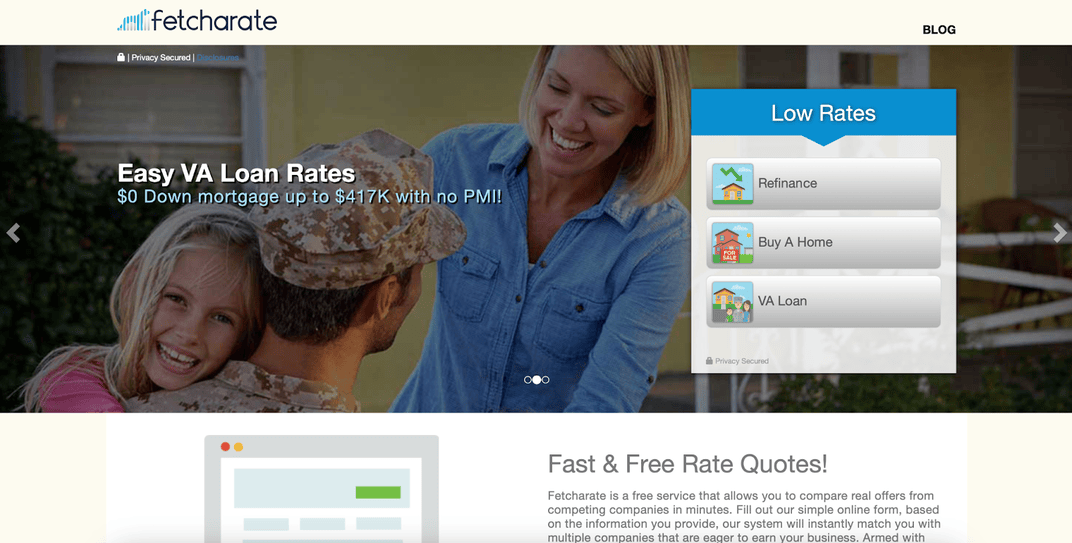
Table of Contents
If you’re thinking of using Fetcharate, you need to know whether it’s safe. Is Fetcharate a scam?
Below, we explain whether Fetcharate is a scam and discuss some steps you can take to improve your safety when using this comparison site.
What Is Fetcharate?
Fetcharate is a comparison site for home loan interest rates. It covers things like fixed-rate mortgages and refinancing.
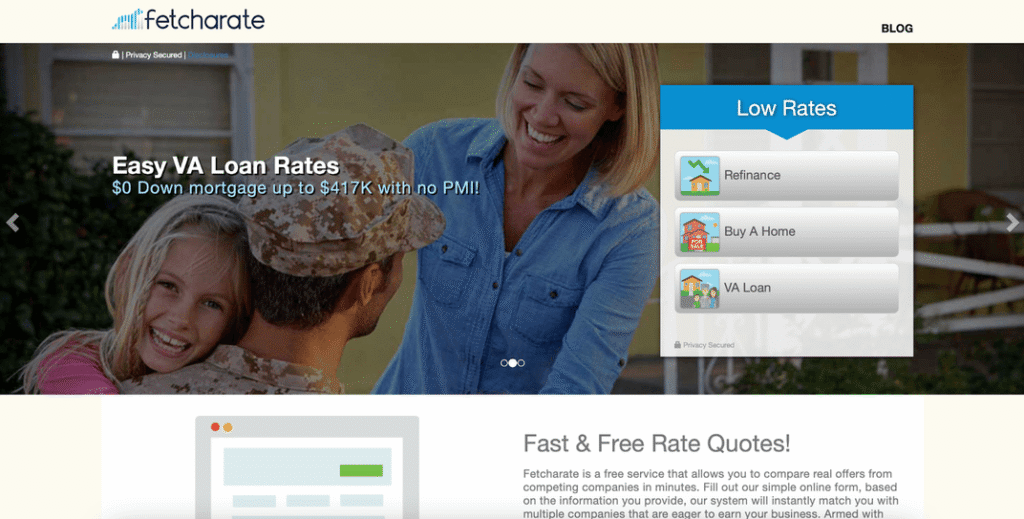
You put in your details to get a “free quote,” and what actually happens is the site passes that information along to mortgage lenders and brokers in its network. They’re the ones who reach out to you after that. So Fetcharate itself isn’t lending you anything. It’s just connecting you with the people who do.
Fetchrate is a subsidiary of LendGo, a company that matches individuals looking for mortgage loans with lenders.
Is Fetcharate a Scam?
No, Fetcharate is not a scam. It’s a legitimate home loan interest comparison site.
That said, the site appears to be relatively low-profile, i.e., there is not much discussion about it online.
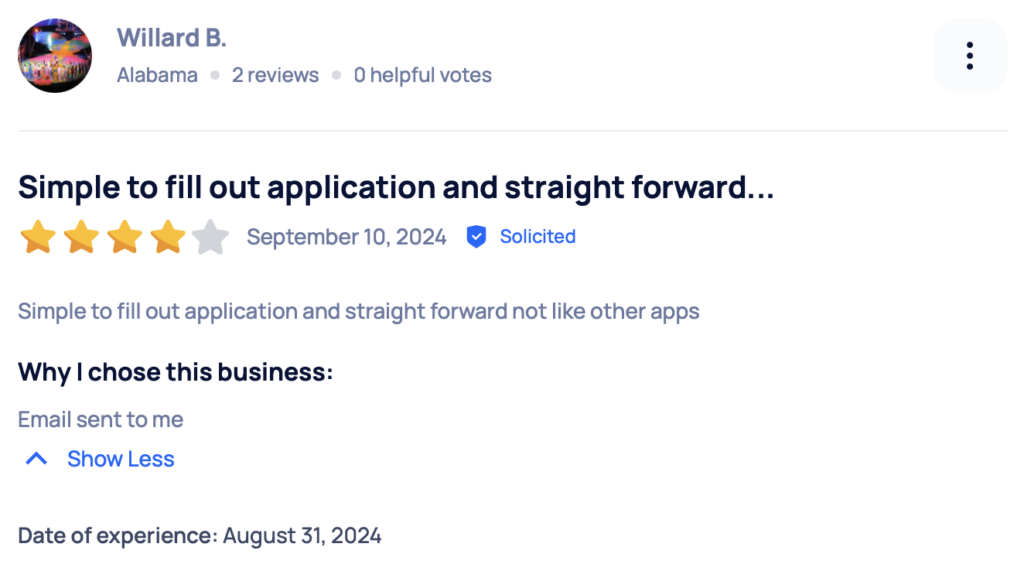
User reviews of Fetcharate are mixed as of this writing. For example, the service gets a 4.2 out of 5.0 stars (from over 25,000 reviews) on Sitejabber and 3.0 out of 5.0 stars (from 2 reviews) on Google.
Positive reviews praise how quick and easy Fetcharate is to use and note that form completion is straightforward.
Negative reviews say that the service does not provide any quotes or information, only a list of lender names and their phone numbers. Multiple people complain about receiving too many calls several minutes after sharing their information on the site.

Fetcharate does not have a Better Business Bureau profile, though its parent company, LendGo, does (and holds an “A+” BBB rating as of this writing. BBB ratings reflect how the BBB thinks a business interacts with its customers).
Fetcharate security
In its privacy policy, Fetcharate briefly describes its security measures.
It says that it uses SSL encryption when you submit sensitive info (e.g., SSN or credit card), restricts employee access, and maintains physical/electronic/procedural safeguards.
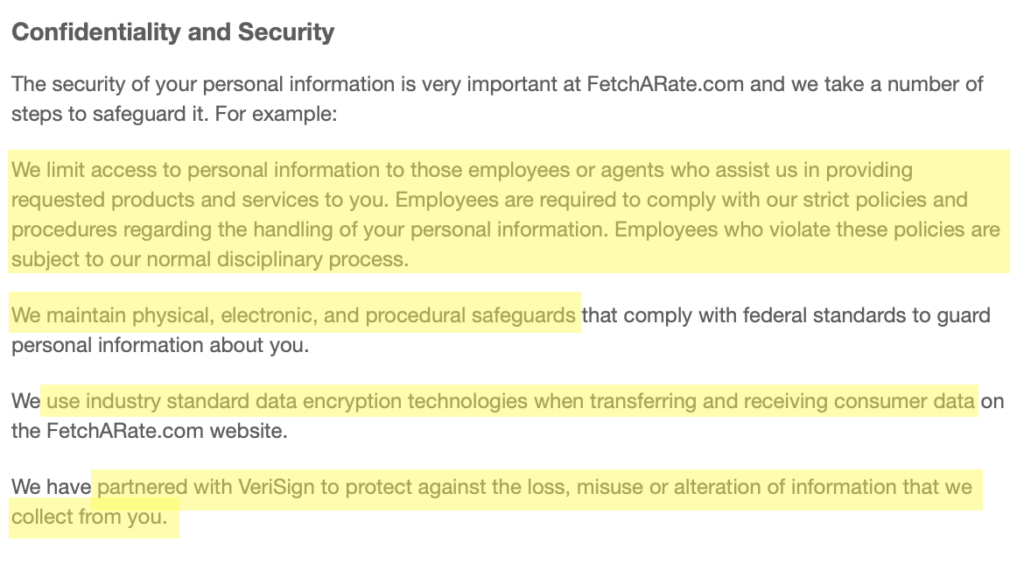
The company mentions partnering with VeriSign for protection against loss/misuse/alteration.
Fetcharate privacy
Fetcharate explains in its privacy policy the kind of data it collects about you, why, and with whom it shares it.
It collects the following personal information:
- Personal information you provide when requesting financial products/services (e.g., name, phone, address, property info/value, and Social Security number), registering for communications (e.g., email address), filling out surveys and forms, or applying for a job with Fetcharate.
- Demographic information (e.g., gender, ZIP code) that Fetcharate describes as not tied to your personal identity.
- Automatically collected data, like cookies, clickstream activity, and IP address.
- Data from other sources or service providers for tracking.
The company notes that it may supplement your information with third-party data (including address/identity verification via TargusInfo and purchased marketing data used to “enhance” your profile).
Fetcharate uses your data to respond to your requests for products/services, process quote/inquiry forms, market products/services/opportunities they think you’ll be interested in (including by using enriched marketing profiles), personalize offers, and measure advertising effectiveness.
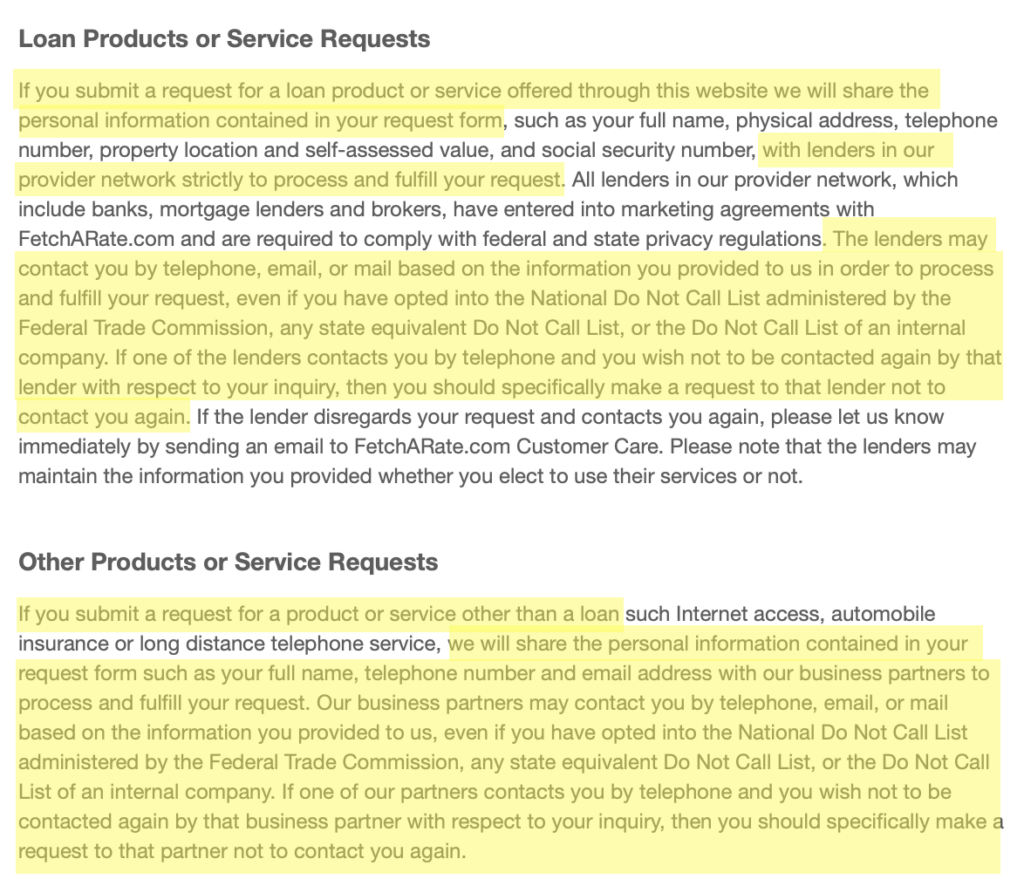
It shares your loan request details (including SSN) with lenders in its network to fulfill your loan request, and with business partners to fulfill your non-loan product requests. Additionally, the company may share your data with service providers (who get limited access and are restricted by confidentiality agreements). Plus, Fetcharate may share your information for legal or safety reasons and in business transfers (i.e., mergers and acquisitions).
Both lenders and partners may contact you by phone, email, or mail, even if you’re on “Do Not Call” lists. You have to opt out with each lender and partner directly, and lenders and partners may keep your information even if you don’t use them.
Fetcharate uses cookies for performance and tracking, as well as third-party ad companies that may use cookies/action tags. It claims that third-party cookie data is anonymous.
It also uses clear gifs/web beacons, including in emails, to track content effectiveness and email opens.
The company says you won’t get its emails unless you submit your email and register, but you might also get emails advertising the company from third-party publishers. You can unsubscribe, but it may take up to 10 business days to stop receiving its emails.
Fetcharate notes that it can’t fully control third-party senders’ mailing lists, and you may need to opt out with those third parties separately.
You can request to correct/update/delete/deactivate your information by contacting Fetcharate’s support.
The company notes that if you email a friend via their referral tool, it sends a one-time invite and doesn’t store the friend’s information.
So, Should You Use Fetcharate?
Depends.
Fetcharate can be a good option if you’re okay with sharing your information in exchange for lender calls. On the other hand, if you want a quiet, private rate comparison without follow-ups, then you may want to look for alternative options.
How to Use Fetcharate Safely and Privately
- Don’t fill in every field (if you don’t have to). Stick to whatever’s strictly needed to get your quote and leave the rest blank.
- Expect phone calls and emails from lenders and partners. Being on a Do Not Call list doesn’t really help here.
- Keep note of who contacts you: Keep a list of lender names so that you know exactly who to opt out of later.
- Set up a throwaway or masked email. This helps keep your primary inbox free of marketing and spam. If you’re a DeleteMe customer, you can use our masked emails.
- Unsubscribe from lenders and partners directly. One thing that might catch people off guard is that unsubscribing from FetchARate doesn’t actually stop the lenders from contacting you. Each one has to be dealt with separately.
- Be careful with your Social Security number. It can get passed along to multiple lenders, and they’re allowed to keep it even if you never end up working with them.
- Use browser privacy tools or extensions to block cookies and trackers where you can. It won’t stop everything, but it helps.
- Look at Fetcharate lenders’ and partners’ privacy policies. Any time you click through to a partner or lender’s site, you’re playing by their privacy rules from that point forward, not FetchARate’s. Worth a quick look at their policy before you start entering anything.
- Ask Fetcharate to delete or deactivate your information. There’s no point leaving it sitting in their system if you’re not using it anymore.
news?

Don’t have the time?
DeleteMe is our premium privacy service that removes you from more than 750 data brokers like Whitepages, Spokeo, BeenVerified, plus many more.
Save 10% on DeleteMe when you use the code BLOG10.