Is Turo a Scam?

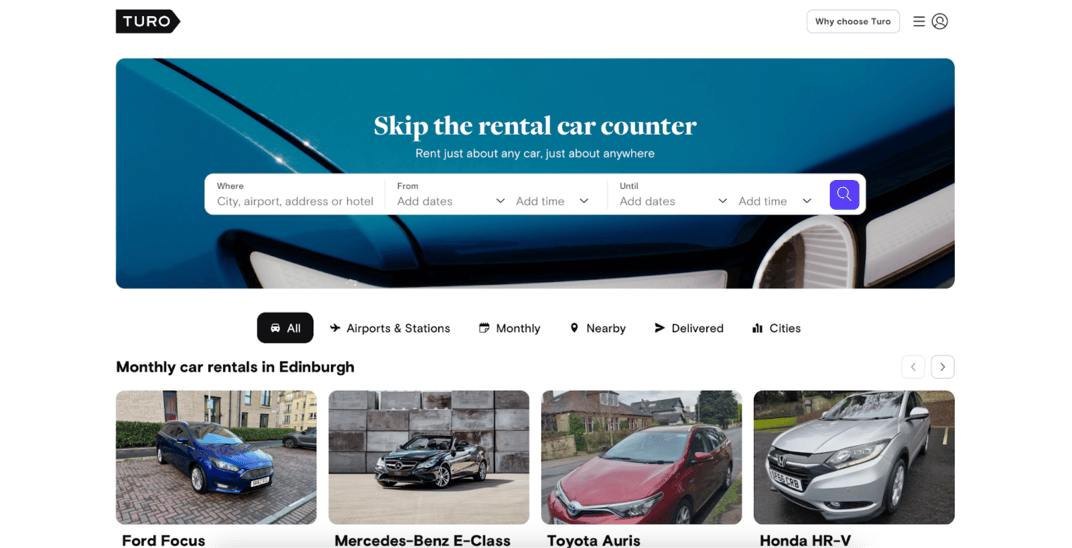
Table of Contents
If you’re thinking of using Turo, you need to know whether it’s safe. Is Turo a scam?
Below, we explain whether Turo is a scam and discuss some steps you can take to improve your safety when using the “Airbnb for cars.”
What Is Turo?
Turo is a peer-to-peer car rental marketplace.
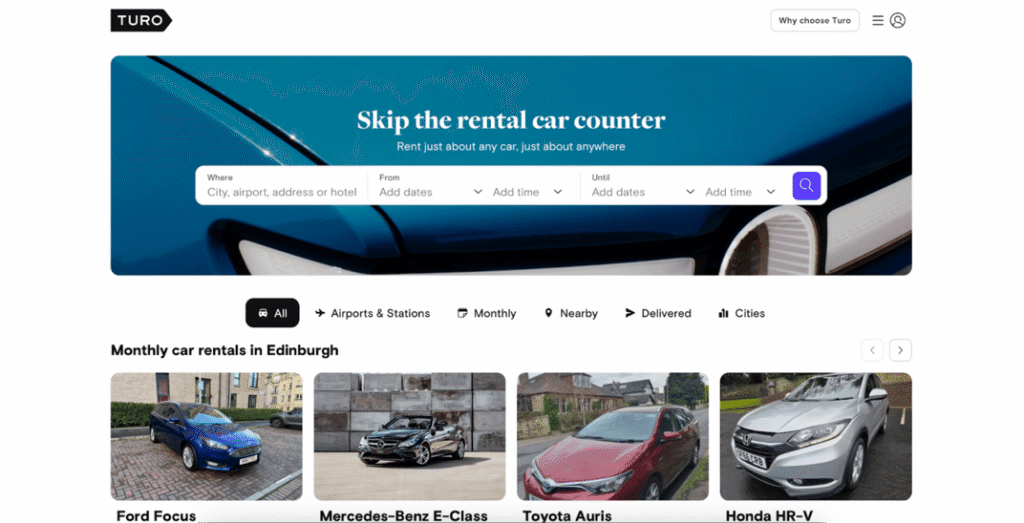
It is often described as the “Airbnb for cars” because it works in a similar way: you search for a car in your location for specific dates through a central platform (you can also use filters like price, vehicle type, etc.) and book directly from the vehicle’s owner.
You then pick up the car (either through contactless delivery or by meeting the vehicle’s owner in person) and bring it back at the end of your trip.
Both hosts and guests can rate each other.
Turo is available in the US and a few other countries, such as Canada, the UK, Australia, and France.
Is Turo a Scam?
No, Turo is not a scam. It’s a legitimate peer-to-peer car-sharing platform.
The company has been featured and reviewed in several third-party publications and review sites, including Nerdwallet, Conde Nast Traveler, CNET, and Nylon.
User reviews of Turo are mixed as of this writing:
- 4.6 out of 5.0 stars (from over 78,000 reviews) on Trustpilot.
- 1.3 out of 5.0 stars (from over 1,100 reviews) on REVIEWS.io.
- 1.08 out of 5.0 stars (from over 550 reviews) on Better Business Bureau.
- 2.2 out of 5.0 stars (from over 300 reviews) on PissedConsumer.
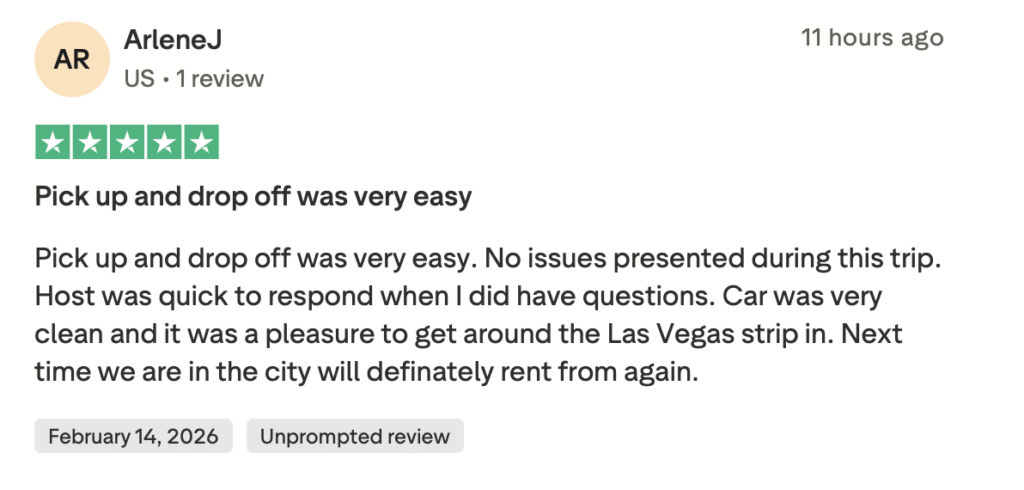
Positive reviews say the platform is very easy to use, noting that it’s very simple to pick up and drop off vehicles. Several individuals note great communication with vehicle owners.
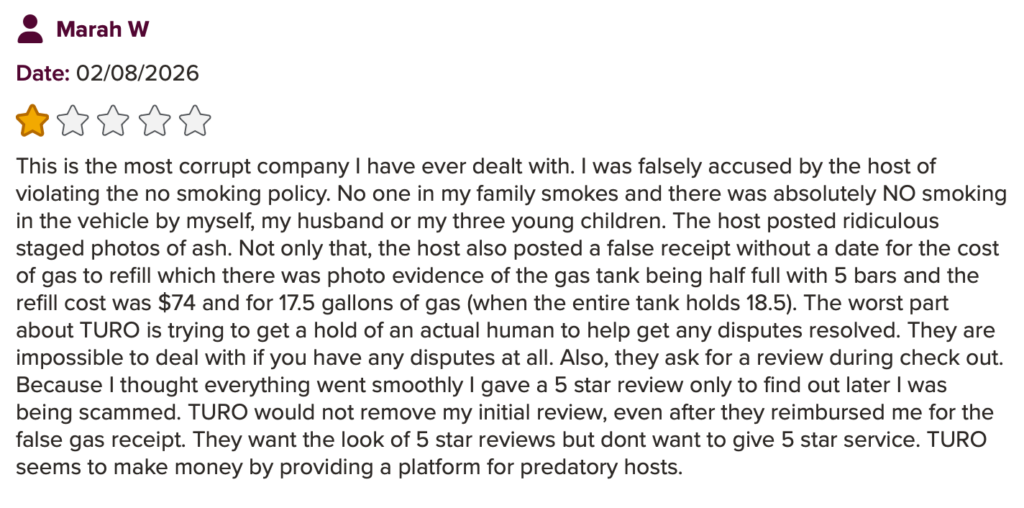
Negative reviews allege fraudulent claims from hosts (for example, one person said they were accused of violating the no-smoking policy), bad customer support, broken vehicles (since they’re privately owned, maintenance standards can vary), and account suspensions.
On online forums like Reddit, people report mixed experiences with Turo. However, overall, the sentiment is positive, with some people saying they’ve had hundreds of positive experiences with Turo.
In response to a thread titled “Has ANYONE had an actual good rental experience on here?” one person writes:
“It is a great service. There is a human element though where conditions, hosts can vary.”

Another says:
“As a renter, I’d say 90% of my Turo experiences have been good or better. Worst complaints are one car was kinda not so clean, another was the host took a bit long to show up to get their car at the agreed return spot, and no explanation or apology.”
That said, several people note bad experiences.
One user reports:
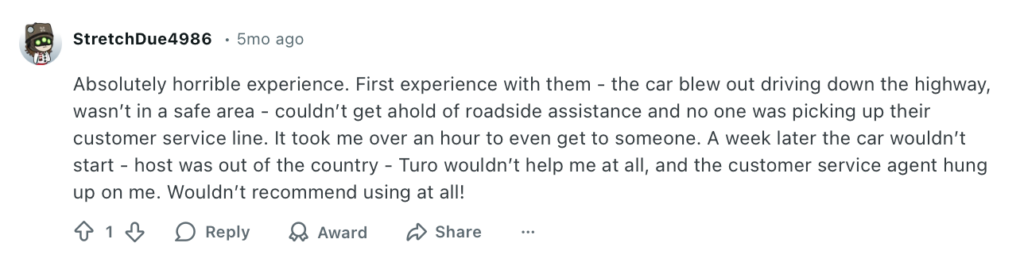
“Absolutely horrible experience. First experience with them – the car blew out driving down the highway, wasn’t in a safe area – couldn’t get ahold of roadside assistance and no one was picking up their customer service line. It took me over an hour to even get to someone. A week later the car wouldn’t start – host was out of the country – Turo wouldn’t help me at all, and the customer service agent hung up on me. Wouldn’t recommend using at all!”
The general consensus seems to be that you have to be careful who you rent from (i.e., you should go with the most experienced hosts and take pictures of any damage, etc., before you drive off).

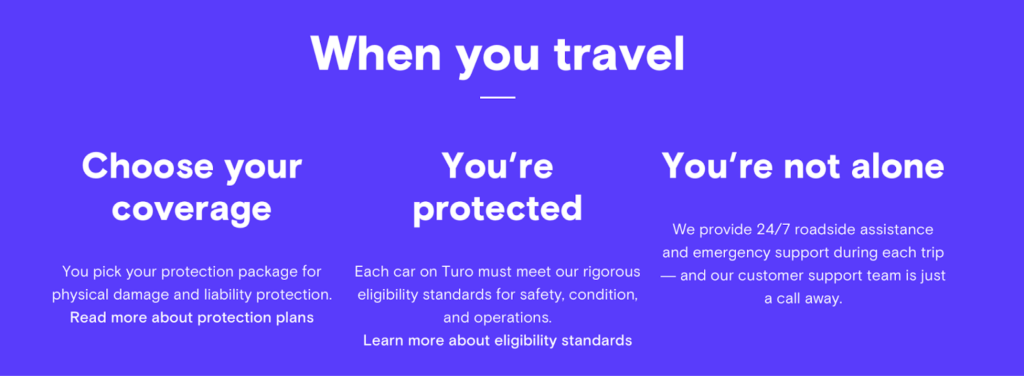
On its website, Turo says that it has rigorous eligibility and quality standards for vehicles (with annual safety inspections required in most geographies), allows guests to choose their coverage, and provides 24/7 roadside assistance and emergency support.
For hosts, Turo says it screens every guest and provides 24/7 emergency support. It also notes that there’s up to $2,000,000 in liability insurance and coverage for physical damage to the vehicle.
Turo is not Better Business Bureau accredited as of this writing, but holds an “A+” rating. BBB ratings are a reflection of how the BBB thinks a company interacts with its customers.
At the time of writing, Turo has received a total of 2,626 complaints on the BBB site in the last three years, 1,175 of which have been closed in the past 12 months.
Complaints center around refund issues, unfair damage claims, account suspensions with no explanations, and poor customer service.
Use of Turo in attacks
Like other vehicle rental services, Turo vehicles have occasionally been misused in criminal incidents.
For example, in 2025, Turo vehicles were used in two violent attacks. A spokesperson for the company said that they don’t believe either person renting the vehicles had a criminal record that would have identified them as a potential threat.
Prior incidents include Turo cars linked to armed robberies, scams, and attempts to resell the rented vehicles.
However, in an article on its site, Turo says that from millions of booked trips, less than 0.10% have resulted in accidents like vehicle theft:
“We have facilitated 27 million trips, over 90 million booked days, spanning 8.6 billion miles driven, through 12 years of operating history, and less than 0.10% of Turo trips have ended with a serious incident, such as a vehicle theft.“
Turo insurance and claims disputes
A class action lawsuit filed against Turo alleges that the company failed to comply with its own terms regarding arbitration fee responsibilities.
Turo security
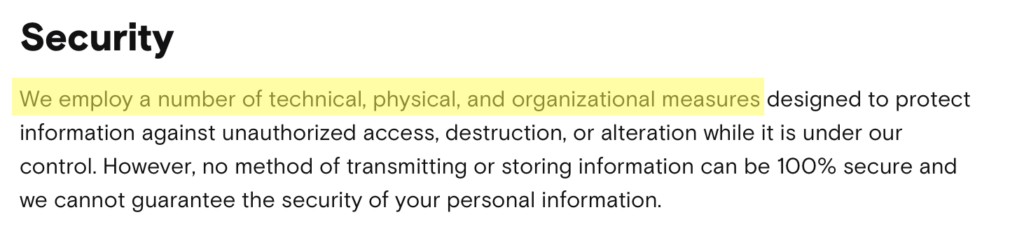
In its privacy policy, Turo briefly explains its security measures.
It says it uses “a number of technical, physical, and organizational measures” to keep your information safe.
Turo privacy
Turo describes in its privacy policy the kind of information it collects, why, and with whom it shares it.
It states that it may collect the following data:
- What you provide directly (account details, profile information, payment data, ID verification, biometrics with consent, and communications).
- What’s collected automatically (usage, device, location, and trip data, plus cookies).
- what comes from third parties (social logins, in-vehicle devices like GPS and telematics, background checks, and information from credit bureaus).
The company uses this data to operate its platform, process transactions, personalize your experience, send communications, conduct research and development, show you targeted ads, verify your identity, detect fraud, ensure everyone’s safety, and comply with legal obligations.
Turo may share your information with hosts (or guests if you’re a host) to make bookings possible (for example, your phone number and driver’s license information), service providers, third-party platforms you’ve connected, professional advisors, and law enforcement or government authorities (when legally required). It may also be shared in the event of a business sale or merger.
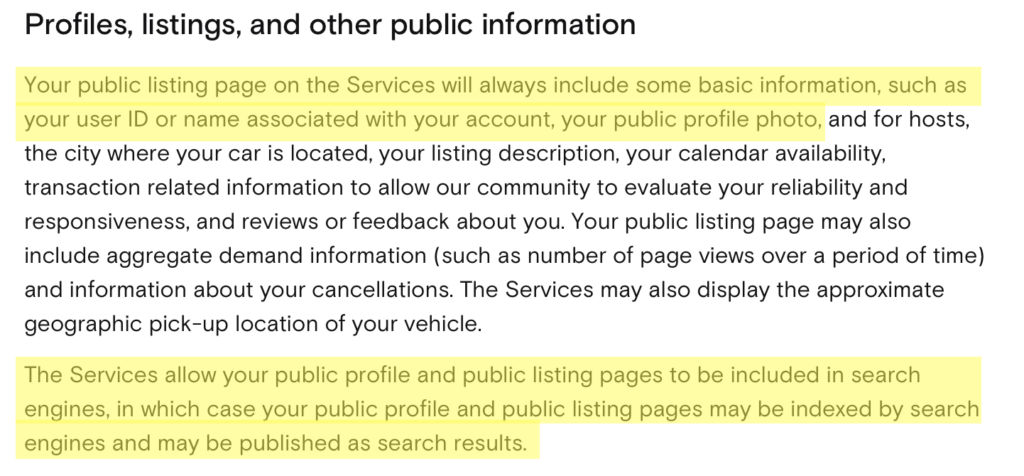
It also warns that your public listing page may include basic information like the name associated with your account and profile photo, and it may be indexed by search engines.
When it comes to your privacy rights, you can manage your notification preferences, opt out of marketing emails and texts, correct or update your information, request Turo to close your account and delete your data, and adjust your preferences for cookies and ad-tracking.
If you reside in California, you have additional rights (i.e., data access, deletion, and correction as well as nondiscrimination).
Users in the UK and Europe have rights under GDPR, including data access, correction, deletion, and data portability, plus the right to object to processing.
Turo says it does not sell personal information under the CCPA definition, though it does use ad-targeting services from Google and Facebook.
Your data may be stored and processed internationally.
So, Should You Use Turo?
Depends.
If you’re comfortable with marketplace-style risks and take precautions (e.g., booking with highly rated hosts and taking photos of any vehicle before you drive off), it can be a good option.
On the other hand, if you want a predictable service and standardized policies and don’t want to manage host variability, a traditional rental may be a better fit.
How to Use Turo Safely and Privately
- Go with the most highly rated hosts. Consistent ratings and good recent reviews reduce the risk of any issues.
- Read the listing and rules. Before booking a vehicle, confirm mileage limits, fuel/charging rules, smoking/pets policies, cleaning expectations, and late-return fees so there are no unpleasant surprises.
- Take pictures or videos of the car at pickup and drop-off. This helps you protect yourself in case there are any damage or smoking disputes.
- Be cautious with contactless pickup and verify identity. Confirm the plate/VIN details, make sure the vehicle matches the photos in the listing, and don’t share any extra personal information beyond what’s needed for the handoff.
- Ascertain safety before you drive away. Check tire condition, warning lights, brakes, lights, etc., so you can report issues before you’re on the road.
- Understand coverage options before booking. Compare protection plans and deductibles ahead of time, so you know what you’d owe if there’s damage, theft, or a claim.
- Use a masked email address and phone number. This limits your exposure and protects your privacy. If you’re a DeleteMe customer, you can use our masked email and masked phone number.
- Keep the information on your Turo profile minimal. Anything you share on your public profile, including your account name and profile picture, can be indexed by search engines and seen by others.
- Redact sensitive details in documents. Share only the required parts of IDs, redacting anything unnecessary to minimize your risk of identity misuse or theft.
- Review vehicle telematics before booking. Ask hosts if the vehicle you’re thinking of renting has monitoring devices to know what driving and location data may be recorded.
- Control location sharing. Turn off precise location access in your phone settings unless you need it for a specific feature like pickup coordination (but remember to turn it off afterwards).
- Be cautious with what trip photos you upload. Don’t upload photos if not necessary, and if you do, avoid capturing personal items, addresses, or bystanders when recording the vehicle’s condition.
- Opt out of marketing and tracking. Take advantage of cookie settings, ad-tracking controls, and unsubscribe links to limit interest-based advertising and promotional messages.
- Keep your Turo account secure. By protecting it with a unique password that you don’t use anywhere else.
- Close your account if you stop using Turo. Ask Turo to delete your account and data if you don’t plan to use the service anymore.
- Understand the kind of information that might be shared with hosts. For example, know that hosts may get your phone number, license validation, and trip details.
- Don’t link third-party accounts unnecessarily. When possible, choose to log in with email rather than social accounts to limit data sharing with external platforms.
- Exercise your rights. Depending on where you live, you may be able to request data access, correction, or deletion.

news?

Don’t have the time?
DeleteMe is our premium privacy service that removes you from more than 750 data brokers like Whitepages, Spokeo, BeenVerified, plus many more.
Save 10% on DeleteMe when you use the code BLOG10.