Is T-Mobile a Scam?

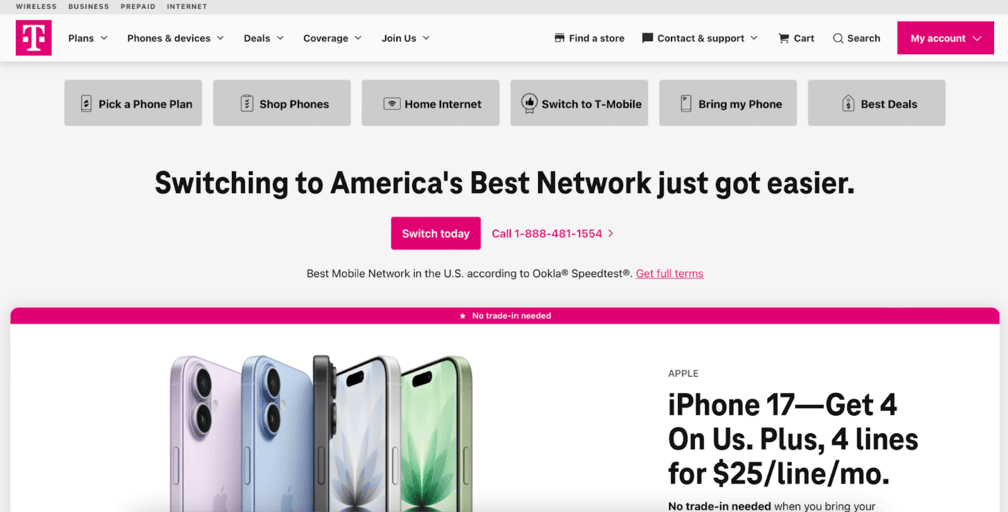
Table of Contents
If you’re thinking of switching to T-Mobile, you need to know whether it’s safe. Is T-Mobile a scam?
Below, we explain whether T-Mobile is a scam and discuss some steps you can take to improve your safety before switching to this wireless network operator.
What is T‑Mobile?
T‑Mobile is the brand used by T‑Mobile US Inc. for wireless voice, messaging, and data services in the United States.
It sells post‑paid and prepaid mobile plans, home internet, and related devices through stores, online, and partners.
T-Mobile operates one of the largest 5G networks in the United States and now owns Sprint. It is one of the country’s top three carriers.
Is T‑Mobile a Scam?
T‑Mobile is a legitimate, regulated wireless carrier and not a scam.
It operates nationwide networks, sells physical products, and is subject to oversight by the Federal Communications Commission (FCC), state attorneys general, and the Federal Trade Commission (FTC).
It must also comply with privacy rules and consumer‑protection laws.
However, the company has a mixed reputation. Data breaches, deceptive advertising settlements, and a past FTC lawsuit for “mobile cramming” have damaged trust. Many customers complain about billing errors and poor customer service.
Third-party publications review T-Mobile favorably.
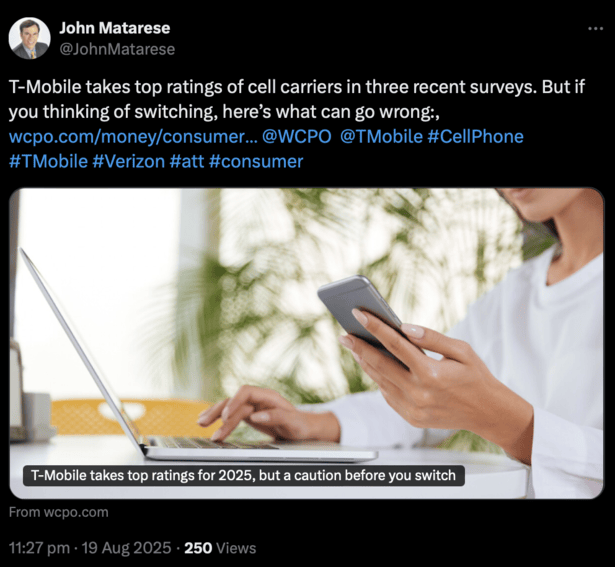
Reporter John Matarese reports that Consumer Reports, CNET, and Tom’s Guide ranked T‑Mobile the best major carrier for 2025 because of lower prices, solid customer service, and an extensive 5G network.
However, user reviews of T-Mobile skew mostly negative as of this writing:
- 1.4 out of 5.0 stars (from over 6,000 reviews) on Trustpilot.
- 1.4 out of 5.0 stars (from over 9,000 reviews) on ConsumerAffairs.
- 2.6 out of 5.0 stars (from over 300 reviews) on Yelp.
- 1.13 out of 5.0 stars (from 3,000 reviews) on Better Business Bureau.
People praise good service in urban areas and responsive corporate office support, but complain about frequent billing discrepancies and inconsistent rural coverage.
On online forums like Reddit, people report varying experiences with T-Mobile.
One person writes:
“T-Mobile is amazing when on major highways. Coverage 99% of the time, borderline gigabit speeds everytime. I will say once you start to go even remotely rural they drop off hard though.”

On the other hand, another person says:
“Customer service is horrid if you need to solve an actual problem.”

T-Mobile is not Better Business Bureau-accredited but holds an “A+” rating. BBB ratings reflect how the BBB thinks the business interacts with customers.
As of this writing, T-Mobile has received a total of 26,766 complaints on the BBB website in the last three years, 7,895 of which have been closed in the past 12 months.
T‑Mobile impersonation scams
As is the case with other big brands, scammers have been known to impersonate T-Mobile.
Fake T-Mobile text and email messages vary, but a common element of these spam messages is a phishing link that doesn’t go to the official T-Mobile website.
Known “T-Mobile” scam messages include:
- A message thanking you for paying your monthly bill and offering a “little gift” or “free gift” that takes you to a phishing site.
- A message about a temporary outage that likewise offers a “gift” as an apology.
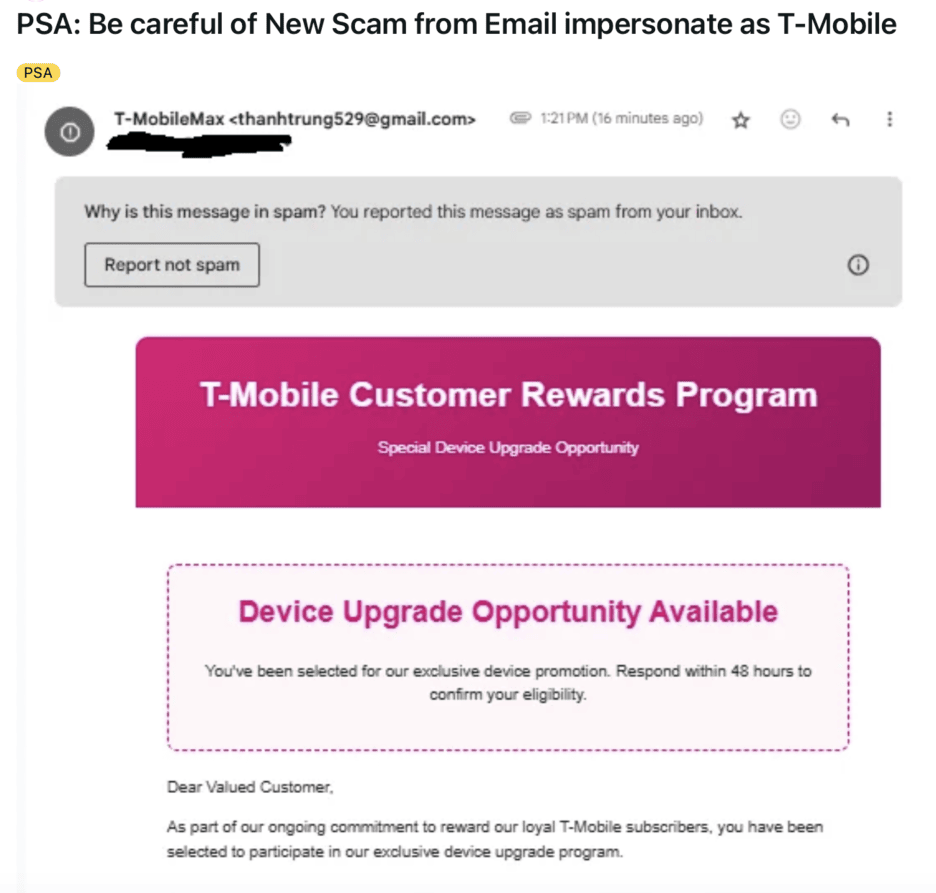
What makes scam texts hard to recognize is that many use T-Mobile branding and logos to appear more legitimate.
Scammers may also call. In one example, scammers reached out to T-Mobile customers, offering them a free phone as a thank-you for loyalty. The scam tricks customers into placing an order for the “free” phone and then has them unwittingly ship it to the fraudsters.
KnowBe4 advises that if someone calls you saying they are from T-Mobile, tell them you will call the company’s main public, legitimate number and inquire about that “great” offer.
T-Mobile regulatory actions & lawsuits
Over the years, T-Mobile has faced multiple regulatory actions and lawsuits related to consumer protection, advertising practices, and data security.
In 2014, the Federal Trade Commission (FTC) sued T‑Mobile for “mobile cramming” after the carrier placed unwanted third‑party charges on customer bills. T‑Mobile agreed to pay at least $90 million in refunds and fines, including $18 million to state attorneys general and $4.5 million to the FCC, and was required to obtain express consent before billing for third‑party services.
In May 2024, a bipartisan coalition of 50 state AGs reached Assurances of Voluntary Compliance from T-Mobile, AT&T, Verizon, and others regarding deceptive ads for “unlimited” plans, free devices, and switcher payments. Carriers committed to truthful disclosures on data caps/reductions, restrictions, and payment details, appointed compliance staff, and trained reps.
In September 2022, T‑Mobile agreed to a $350 million class‑action settlement after a 2021 data breach exposed information of roughly 76 million people. The company promised to provide two years of identity‑protection services and invest $150 million in cybersecurity improvements.
In October 2024, the FCC announced that T‑Mobile would pay a $15.75 million civil penalty for multiple data breaches in 2021–2023 and would invest another $15.75 million to upgrade cybersecurity with zero‑trust architecture and phishing‑resistant multi‑factor authentication.
T-Mobile security
T‑Mobile is a licensed wireless carrier subject to FCC oversight and state consumer‑protection laws.
T‑Mobile promotes a range of account‑protection tools. For example, customers can enable SIM Protection to lock their SIM card and set a strong PIN.
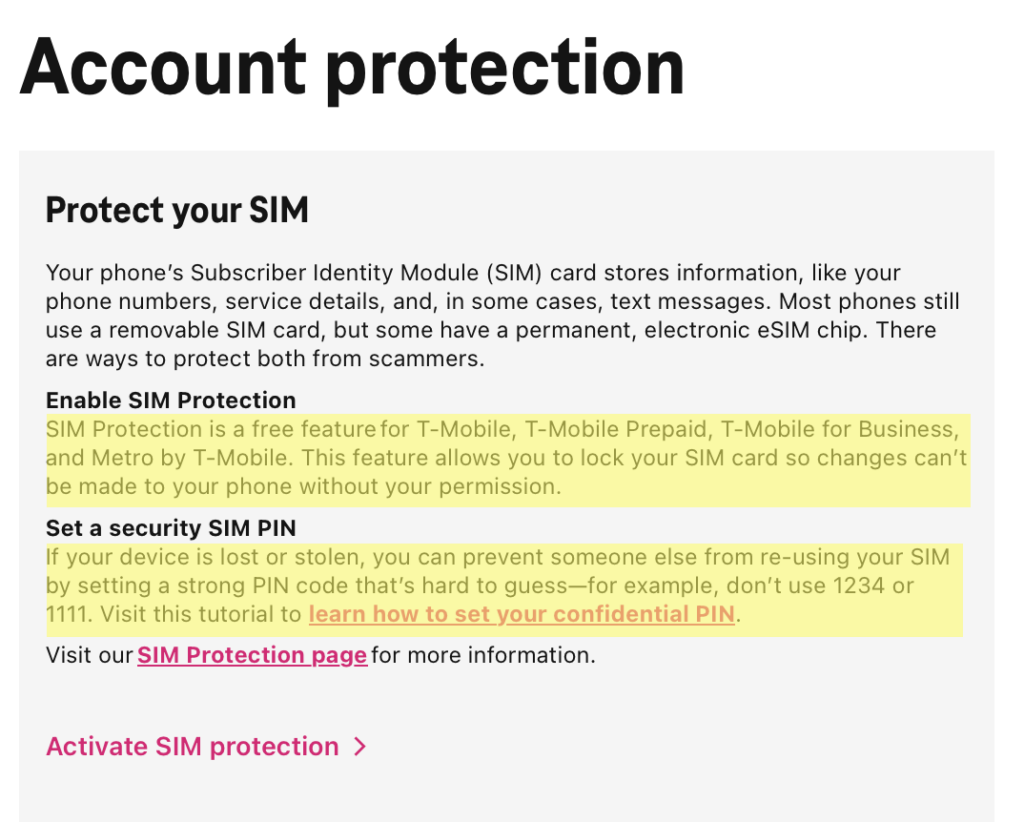
There’s also a feature called Port‑Out Protection, which prevents unauthorized number transfers.
The company advises reporting suspicious messages to 7726 and offers Scam Shield and Scam Block to identify or block scam calls.

T‑Mobile’s privacy notice explains that it tracks how well its security is working and invests in improving it, follows industry best practices to spot and evaluate threats, hires outside experts to test its defenses and find weaknesses, and trains its employees on how to protect data and systems.

T-Mobile privacy
This section looks at T-Mobile’s privacy, most notably, its privacy policy.
T-Mobile privacy policy
T-Mobile explains in its privacy policy the kind of data it collects, why, and with whom it shares it.
Note that some T-Mobile products (financial services, kids devices, biometrics, etc.) have separate privacy notices that may override the company’s general policy.
The policy includes a dedicated consumer health data section covering biometric verification, disability/accessibility data, health and safety incident reporting, and Safe Connections Act requests for domestic violence survivors.
T-Mobile may collect the following personal information:
- Name, contact information, and billing and payment details.
- Government ID (driver’s license, passport, and SSN).
- Device and network usage (apps, websites, IPs, and data usage).
- Location (general and sometimes precise).
- Demographics (age, gender, and interests).
- Call and text metadata (CPNI).
- Audio & video recordings (customer service calls and store cameras).
- Biometric data (face scan and voiceprint for ID verification).
- IoT data (connected cars, watches, and smart devices).
- Children’s data (SyncUP Kids Watch).
- Advertising identifiers (MAID).
It collects this data directly from four sources: you (e.g., when you create an account, make purchases, set preferences, contact support, etc.), automatically (from your device, network usage, apps, websites, store visits, Wi-Fi/Bluetooth, cookies, location, etc.), from other companies (such as its business partners, social media, advertisers, financial institutions, credit bureaus, and data brokers), and by creating/inferencing data (i.e., predicting your interests, likely purchases, device preferences, etc.).
The company uses this data to provide its services, prevent fraud, protect accounts, verify identities, show targeted ads and offers, and develop products. Plus, for analytics, reporting, and legal compliance.
T-Mobile may share your information with service providers and vendors, analytics companies, advertising networks, social media companies, financial institutions, business partners, affiliates, acquiring companies, law enforcement, regulators, Caller ID providers (your name and phone number), and account holders (if you’re a user on someone else’s account).
It may share your data for business operations, targeted advertising (unless you opt out), with your consent, and for legal and security reasons.
The company may also share de-identified/aggregated data.
When it comes to sensitive data (SSN, government ID, financial account information, precise location, biometric data, etc.), T-Mobile says it only uses it for required business/legal purposes. It also says that it doesn’t sell/share this data for targeted ads without permission.
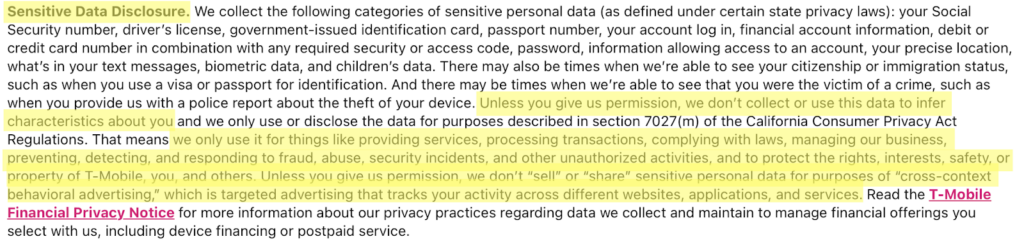
It says it doesn’t knowingly sell or share data of minors under 18.
T-Mobile runs several ad programs (managed via Privacy Dashboard):
- Relevant Ads: Based on app usage, interests, and demographics.
- Tailored Offers & Ads: More personalized using location, browsing, purchases, and CPNI.
- Advertising Solutions: Advertisers upload MAIDs to target devices.
It builds interest groups and profiles and shares them with ad partners.
Users have certain privacy rights. For example, you can access, correct, and delete your data (with some legal exceptions). You can also opt out of targeted ads, data sale/sharing, analytics, and fraud-sharing. Plus, you can control how financial data is shared and opt out of profiling and automated decisions. You can manage all these choices through your T-Mobile Privacy Dashboard.
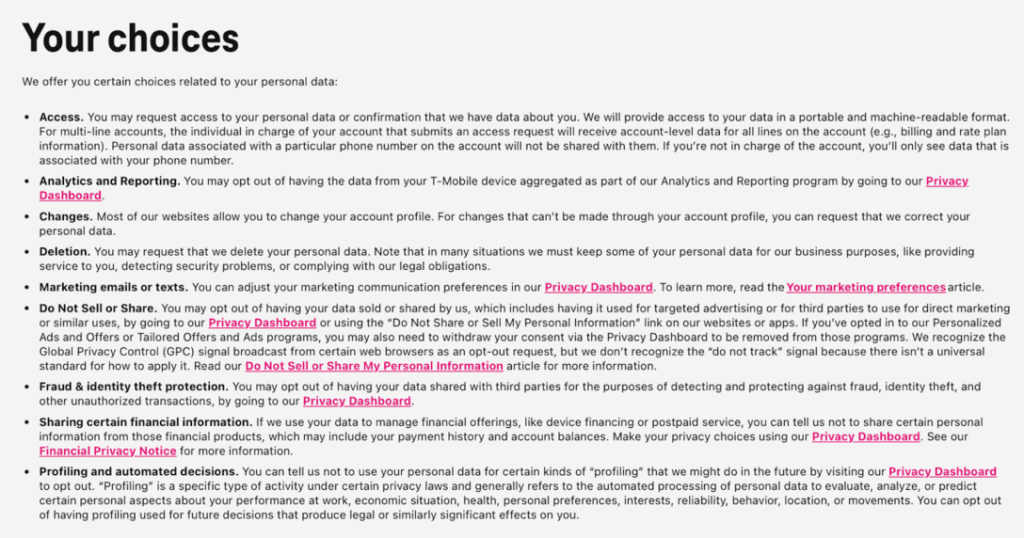
T-Mobile honors the Global Privacy Control (GPC) browser signal.
It says it keeps data only as long as necessary for business or legal reasons.
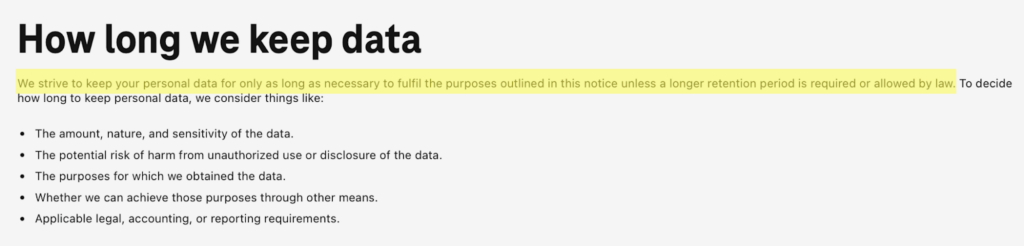
The company processes your data mostly in the US, but it may also be transferred internationally.
Third-party evaluation of T-Mobile’s privacy policy
The Common Sense Privacy Program, which evaluates internet services’ privacy policies, gives T-Mobile’s policy a score of 54% out of 100%, which is a “Warning” rating. This means “Does not meet our recommendations for privacy and security practices.”

Among the potential concerns flagged are the sale or rental of personal information to third parties, the display of personalized ads, and the collection of data by third parties for their own purposes.
Additionally, user information is used to track and target ads on other third-party websites or services, and data profiles are created and used to deliver personalized ads.
So, Should You Use T‑Mobile?
Depends.
Major reviewers rank T‑Mobile’s network as a top performer, but it may not be the best fit if you are sensitive to data‑privacy risks or live in rural areas with inconsistent coverage.
Consider your coverage needs, risk tolerance, and privacy preferences before choosing.
How to Use T-Mobile Safely and Privately
- Change key settings in your T-Mobile Privacy Dashboard. Opt out of “Do Not Sell or Share,” opt out of Analytics & Reporting, turn off or don’t opt into Tailored Offers & Ads, and opt out of “Sharing for Fraud & Identity Theft Protection” if you don’t want indicators shared with other companies (though note that the tradeoff is less fraud-sharing support).
- Minimize ad tracking on your phone. T-Mobile uses your MAID (mobile advertising ID) to deliver “Relevant Ads” and to target/exclude devices. Reset or limit your device’s advertising ID (OS setting), and avoid opting into ad programs in the Dashboard when possible.
- Reduce precise location use where you can. Don’t grant optional permissions for precise location tied to ads/offers. Only allow precise location when you actually need a location-based feature.
- Be cautious with web/app tracking. Use cookie and/or opt-out controls and use the minimum necessary web/app interactions (e.g., don’t fill optional fields).
- Lock down your SIM and phone number. T-Mobile customers have been targeted in SIM-swap and port-out attacks. To prevent these attacks, turn on SIM Protection and Port-Out Protection, and ensure your account is protected with a strong PIN.
- Be skeptical of “T-Mobile” texts and calls. Scammers regularly impersonate T-Mobile with fake bill payment confirmations, “free gift” offers, fake outage apology messages, and “free phone for loyalty” calls. To be safe, never click links in T-Mobile texts or share details with inbound callers. Always call back using T-Mobile’s official number.
- Turn on Scam Shield & Scam Block. T-Mobile offers built-in tools to identify scam calls, block known fraud numbers, and flag spoofed caller IDs.
- Limit what information you share in support chats and calls. Customer service calls may be recorded. The same goes for content you send to support. Share only what’s really necessary to solve the issue.
- Protect your T-Mobile account. Use a strong, unique password for your T-Mobile ID.
- Understand “CPNI.” T-Mobile collects CPNI (call details like type/location/destination/amount, plus call detail info) and says some uses/sharing happen with opt-in consent (including ad programs). Don’t opt in to CPNI-based marketing uses unless you truly want those personalized offers.
- Think twice about “extras” that expand data collection. Some services inherently involve more data. If privacy is the priority, avoid or tightly limit these.
- Be mindful in T-Mobile retail stores. Some stores track aggregate traffic patterns using Wi-Fi/Bluetooth identifiers, and stores may have video recording. If you want to reduce Wi-Fi/Bluetooth-based tracking, keep Wi-Fi/Bluetooth off while in-store (or on but not discoverable, depending on your device controls).
- Exercise your privacy rights. You can request data access, corrections, and deletion (with some exceptions).

news?

Don’t have the time?
DeleteMe is our premium privacy service that removes you from more than 750 data brokers like Whitepages, Spokeo, BeenVerified, plus many more.
Save 10% on DeleteMe when you use the code BLOG10.
Related Posts

Is Clawee a Scam?