The Canvas Hack: The New Logic of Cyber Extortion

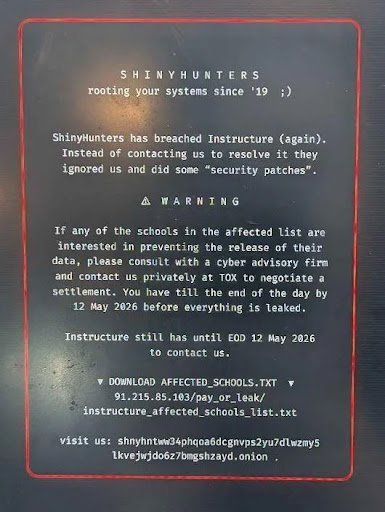
On May 7th, when many students logged into Canvas (a popular Learning Management System), they were not greeted by coursework, assignments, or exam materials. They were greeted by ShinyHunters.
This image came from a UMass Amherst subreddit: “Instead of contacting us to resolve it they ignored us and did some ‘security patches.’”
That line felt strange immediately.
Traditional ransomware messages usually sound blunt and mechanical. Pay the ransom. Recover the systems. Avoid the leak.
The Canvas hack felt different from the beginning. Even before the full scope of the Canvas data breach became clear, the attack already felt designed to create pressure as much as disruption.
According to public reporting, the attackers behind the breach reportedly gained access to parts of Instructure’s Salesforce environment through a social engineering attack targeting the company’s sales organization. That detail matters because it potentially explains how the attackers were able to identify downstream institutional relationships, understand where operational pressure would accumulate fastest, and turn disruption into leverage at scale.
Understanding how organizations communicate, where dependency exists, and how disruption spreads gives attackers far more precision once an incident becomes public.
Leverage comes from understanding the environment well enough to turn uncertainty, visibility, and dependency against the organizations caught inside it.
The message read like a negotiation that had escalated into public pressure rather than a conventional ransomware demand.
Once the disruption spread outward to students, professors, and administrators, the attack stopped looking like a private extortion attempt entirely. Everyone connected to the platform became part of the pressure surrounding it.
The breach itself was serious. Instructure later confirmed that an unauthorized actor accessed portions of its environment and temporarily altered login pages before the company pushed Canvas into maintenance mode to contain the incident. Reuters later reported that Instructure reached an agreement tied to the return and deletion of stolen data.
But the most revealing part of the incident was how clearly the attackers understood where disruption would spread fastest.
The Canvas Hack Was About Operational Pressure
Canvas is not just another software platform for most universities. It sits directly in the middle of academic operations.
Assignments move through it. Professors distribute exams through it. Students submit final work through it. Messaging, grading, course coordination, and academic scheduling all depend on it functioning normally.
During finals week, those dependencies become concentrated.
According to public reporting and institutional notices, some universities postponed exams, extended assignment deadlines, or shifted into emergency communication workflows after login functionality and course access were disrupted during finals week. Faculty and administrators were forced to improvise alternative methods for distributing materials and communicating with students while institutions worked to stabilize operations.
Temporarily disrupting a platform thousands of institutions relied on during finals week was enough to create chaos across the academic system.
Modern Cyber Extortion Increasingly Relies on Visibility
Attackers no longer need to completely destroy systems to create leverage. In highly connected environments, even temporary instability can create cascading pressure once core workflows begin failing.
In highly connected systems, even limited disruption can create enormous pressure once attackers understand where institutional dependency is concentrated.
The disruption spread socially almost as quickly as it spread technically once the platform became unstable.
Modern threat groups increasingly build that understanding from exposed data, employee information, third-party systems, and the broader identity attack surface organizations expose over time.
Groups like ShinyHunters are often described primarily as data thieves, but many of the most effective modern cybercriminal groups increasingly behave more like social engineers.
In incidents like this, the exposure extends well beyond the compromised platform itself.
The Line Between Extortion and Operational Disruption Is Blurring
“Instead of contacting us to resolve it…”
The message framed the situation less like a ransomware demand and more like a negotiation that had escalated into public pressure. Once students, professors, and administrators were pulled into the disruption, everyone connected to the platform became part of the leverage surrounding it.
The goal did not appear to be pure destruction. The disruption itself was the leverage. Finals week created urgency in much the same way attackers increasingly exploit high-pressure moments inside organizations. Login instability created uncertainty, and public visibility amplified both almost immediately.
ShinyHunters claimed the compromised data pool reached up to 275 million records across nearly 9,000 educational institutions, though Instructure has not publicly confirmed those figures.
Whether the final number proves accurate or not, the broader pattern is already clear. The more centralized and widely relied upon a platform becomes, the more disruptive even temporary instability can be once trust in the system starts breaking down.
Why the Canvas Breach Reflects a Larger Shift
The Canvas breach exposed how dependent modern institutions have become on platforms most people barely think about until they stop working.
Once Canvas became unstable, institutions were forced into improvised communication and workflow recovery during one of the most stressful weeks of the academic year.
The disruption spread through the people and systems connected to the platform almost immediately.
And attacks like this do not happen in a vacuum.
Groups like ShinyHunters succeed because they understand how organizations function and how exposed personal data can support modern social engineering attacks. That understanding is often built from the enormous amount of publicly accessible information organizations generate around employees, vendors, workflows, and public-facing systems every day.
Which means defending against attacks like this is no longer just about what happens after a compromise occurs.
Limiting how much organizational visibility attackers can gather before attacks begin matters just as much.
To learn how DeleteMe helps organizations reduce exposed personal data and limit the visibility attackers use to fuel social engineering and extortion campaigns, schedule a conversation with our team.

news?
Is employee personal data creating risk for your business?
Is employee personal data creating risk for your business?
Related Posts

10 Ways to Reboot Your Privacy at Work

2022 Cybersecurity Excellence Award: Our Journey & Future