The Problem with Ads in ChatGPT

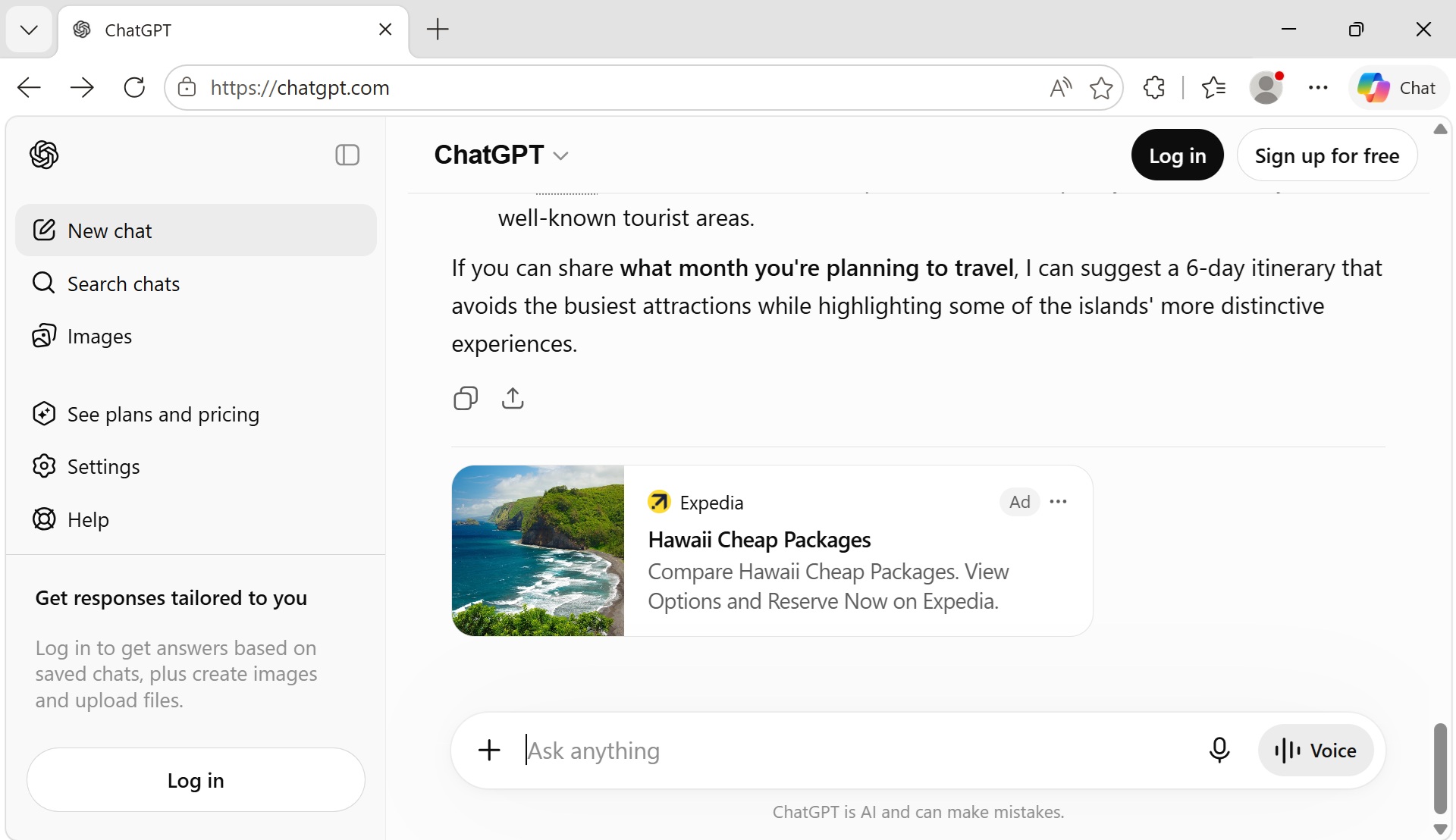
When OpenAI’s ChatGPT first emerged in 2022, there were no ads. It was a free tool for anyone to use without popups or product recommendations.
In February, 2026, OpenAI began to roll out ads in chats for free and Go plan users, so we decided to find out, could ads in ChatGPT put your privacy and safety at risk?
Key takeaways:
- Google, Meta, TikTok, and OpenAI have all made similar promises to ensure high-quality ads.
- Google, Meta, and TikTok are known to allow 73% of scam ads to persist even after consumers report them.
- OpenAI’s promised moderation measures are unlikely to prevent scam ads in ChatGPT.
- Report fraudulent ads, treat sponsored content with suspicion, and consider paying for a higher tier-membership to remove ads entirely.
The history of ads in ChatGPT
In 2022, OpenAI created ChatGPT. This was followed by similar tools offered by Meta, Google, and Anthropic.
Initially, Sam Altman said that ads would be a “last resort,” as Business Insider reported early this year. As profitability continued to be a struggle, the company explored multiple options for financing continued development. That included multiple paid tiers and usage options.
In the end, OpenAI integrated ads into its chatbot outputs.
- November 30, 2022 — ChatGPT launched as a completely free research preview.
- February 1, 2023 — ChatGPT Plus launched at US$20/month, becoming the first paid subscription tier.
- August 2023 — ChatGPT Enterprise was introduced for organizations, with enterprise security, admin controls, and higher usage limits.
- January 2024 — ChatGPT Team, later renamed ChatGPT Business, launched for small teams and businesses.
- 2024–2025 — Additional premium tiers, including ChatGPT Pro, were introduced to provide substantially higher usage limits and access to the most advanced models and features.
- August 2025 — The Go plan began rolling out in selected markets at $8/month as a lower-cost paid subscription positioned between the free tier and Plus.
- February 2026 — Ads were introduced for users on the Free and Go plans in supported regions. Sponsored content appears separately from ChatGPT responses and does not affect the assistant’s answers.
OpenAI claims that ads will in no way influence organic chatbot answers and will always be clearly labeled, according to the principles laid out on its website.
It also claims it will prioritize privacy, user experience, and user trust over revenue and that ads will not be invasive.
Lastly, OpenAI promised its ads would be “useful, entertaining, and help people discover new products and services.”
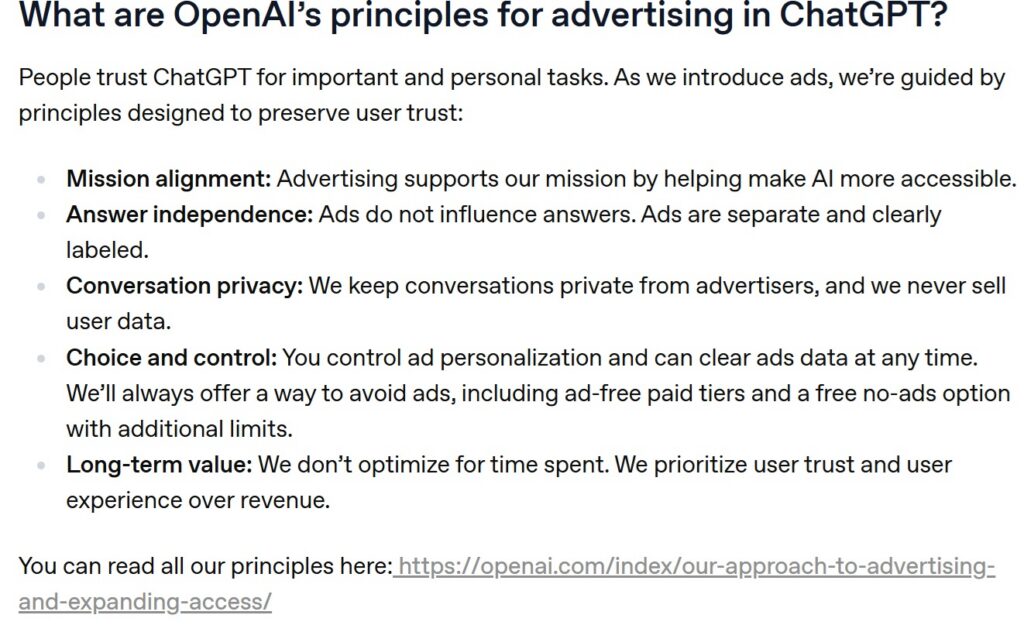
Journalists who investigated the ads report OpenAI quickly broke that last promise. Ads in ChatGPT are large, distracting, and often irrelevant, said PCMag’s Emily Forlini.
How do ChatGPT ads work?
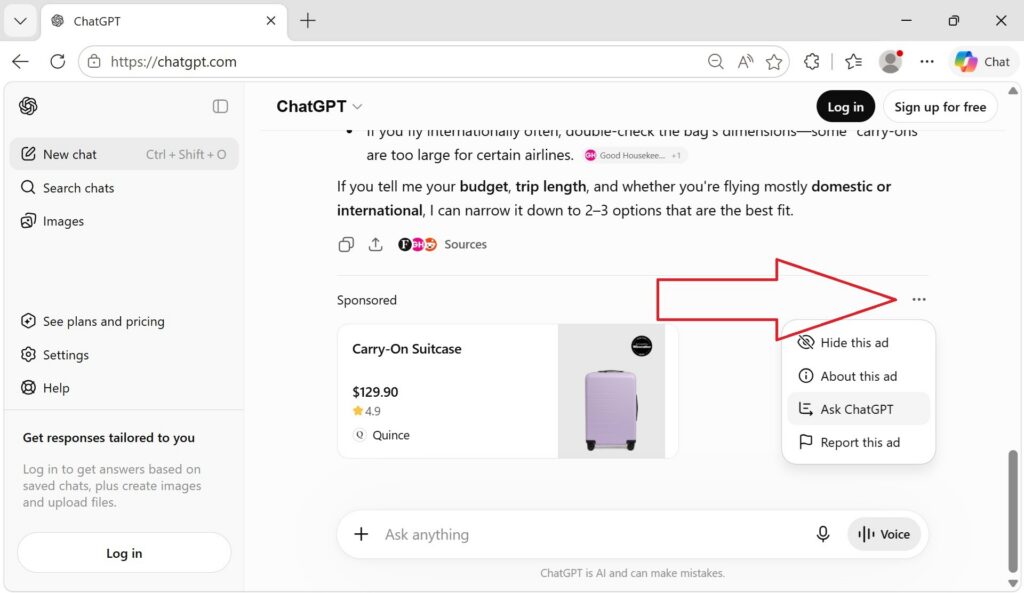
OpenAI takes signals directly from your chats to decide what ads to show. If you ask about luggage or travel, you will see related advertisements at the bottom of ChatGPT’s response.
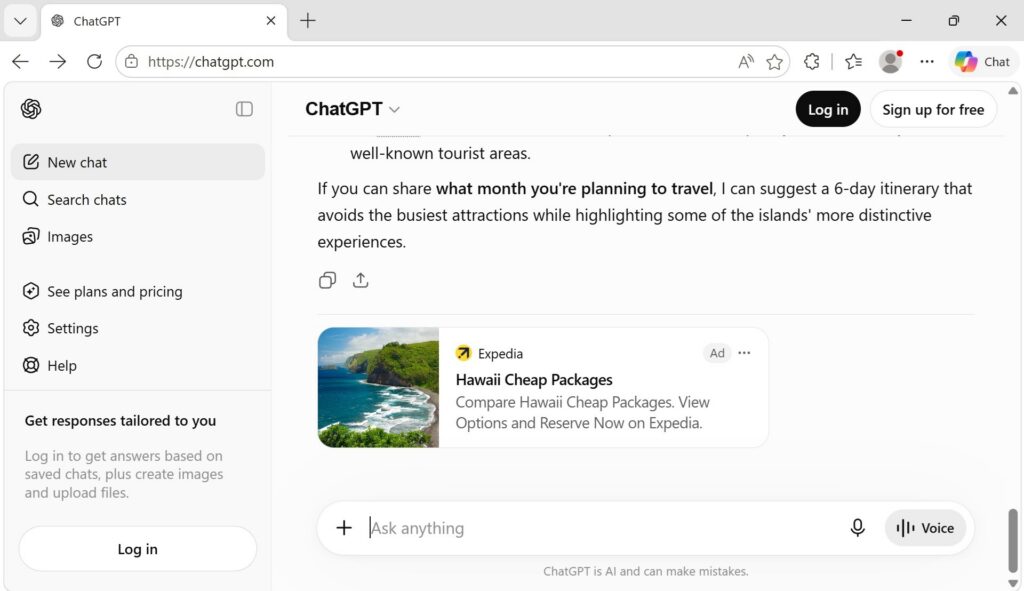
You can see an example in the image below. By clicking the three dots at the top right of any ad, you can choose to hide the ad, learn more about the ad, ask ChatGPT about it, or report the ad.
Ads are restricted for certain topics, including sensitive mental and physical health topics.
OpenAI’s ad policies also prohibit “misleading or deceptive ads” and scam ads.
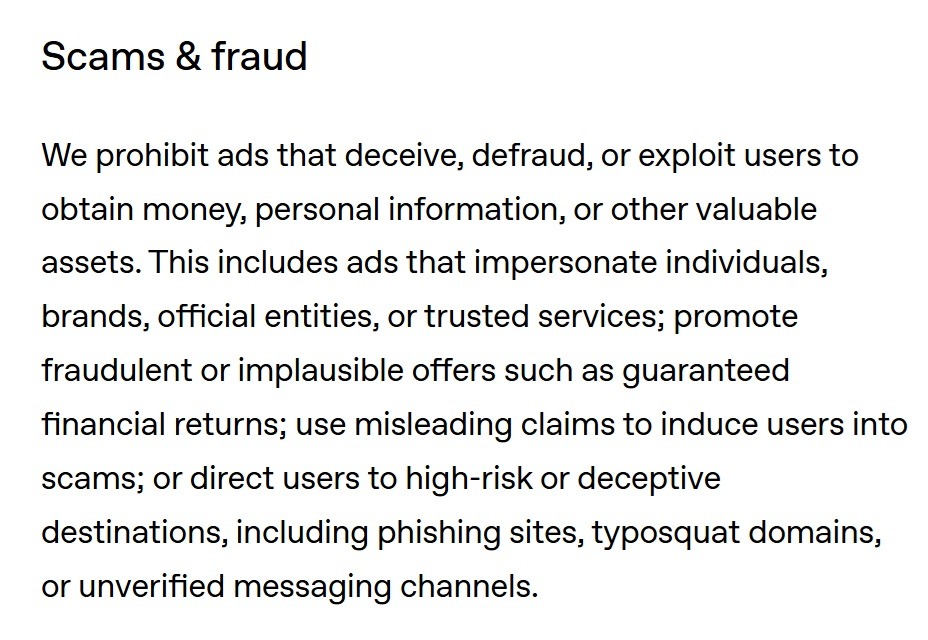
Other prohibited categories include:
- Sensitive user contexts
- Harmful or controversial topics
- Adult content
- Alcohol and tobacco
- Recreational drugs
- Gambling
- Healthcare and regulated medicine
- Legal services
- Political content
- Unsubstantiated wellness claims
- Financial services and crypto
- Deceptive and low-quality content
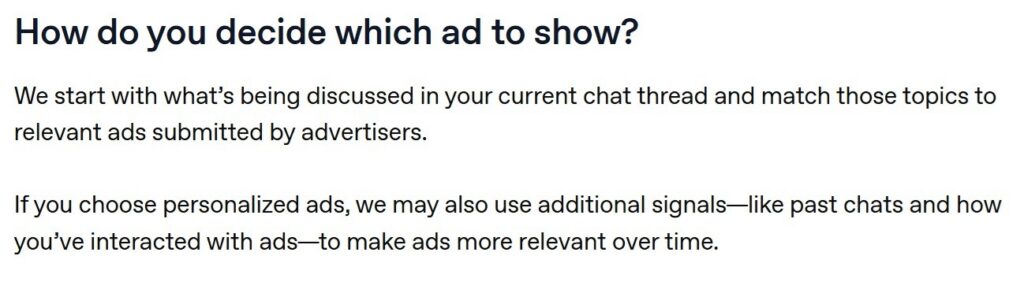
According to OpenAI, it doesn’t share your personal information with advertisers. Only ChatGPT will personalize ads based on your current and previous chats.
If you have a Go plan, OpenAI will also base ads on ChatGPT’s “Memory” feature, which collects facts about you based on your previous interactions.
Big tech and the scam ad problem
Users see dozens of ads every day on the internet, often served by Google, Meta, or TikTok. Each of those tech companies promise to prevent scam ads and regulate the types of content that can appear in advertisements.
In many cases, they don’t or can’t follow through.
1. Google and scam ads
In Google’s 2025 Ads Safety Report, the company claimed: “In 2025, Gemini-powered tools dramatically improved our ability to detect and stop bad ads: Our systems caught over 99% of policy-violating ads before they ever served, and we’re continuing to evolve our defenses to stay ahead of even the most advanced schemes.”
Also in 2025, Malwarebytes reported on a new threat vector. Malicious actors use fraudulent Google advertisements to phish ad account credentials. Here’s how it works:
- Scammers pay for a sponsored ad to be shown at the top of Google search results. That sponsored ad will appear to be from Google Ads itself, encouraging advertisers to log in.
- A would-be advertiser clicks the link and goes straight to what appears to be a Google Ads sign-in interface.
- The would-be advertiser signs in, the page harvests the credentials, and now the cybercriminals have access.
In June of 2026, cryptocurrency investors lost $400,000 to another fraudulent Google ad campaign, says TradingView.
In 2021, the BBC reported that Google failed to remove 34% of reported fraudulent ads. That percentage has since increased rather than decreasing.
2. Meta and scam ads
A 2025 statement from Meta published in Reuters shared, “Over the past 18 months, we have reduced user reports of scam ads globally by 58 percent and, so far in 2025, we’ve removed more than 134 million pieces of scam ad content.”
In June of 2026, a Consumer Federation of America lawsuit alleged that Meta projected more than 10% of its revenue in 2024, around $16 billion, would come from fraudulent ads. A Meta representative later corrected that the real figures were probably closer to 3-4%, still a massive number if true.
Meta charges scammers extra to post ads and continues to show roughly 15 billion questionable or fraudulent advertisements to users every day, according to Reuters. In May of 2026, NBC News reported that the 30 most active scam accounts on Meta generated 215 million impressions and continue to pay for fraudulent ads that specifically target older adults.
3. Tiktok and scam ads
TikTok’s policies “prohibit behaviors that are misleading, inauthentic, and deceptive in order to protect the integrity, authenticity, and safety of our viewers and our platform. Accounts that engage in these behaviors or exhibit patterns of abuse may be suspended or banned.”
As research from European consumer groups spanning more than 13 countries recently showed, these same platforms failed to act in 73% of cases in which users reported scams and fraudulent advertising.
4. OpenAI and scam ads
Up to now, there are no widespread accounts of fraudulent ads in ChatGPT. So far, OpenAI seems to approve relatively few advertisers and has not fully scaled its ad revenue system.
However, OpenAI has started to show warning signs of a similar trajectory to the companies above. While it does have measures in place to moderate ad content and ensure user privacy, those measures are heavily flawed.
Does OpenAI do enough to prevent scam ads in ChatGPT?
OpenAI already has a major vector for scams even without sponsored ads. According to a 2026 report from The Guardian, ChatGPT regularly recommends scam products and websites in organic chatbot interactions.
Read more on this topic from the DeleteMe team in our piece on ChatGPT shopping scams.
Who is to say that advertisements will be any different?
OpenAI does have moderation policies and systems in place. Those systems involve multiple steps, starting with AI and LLMs. Artificial intelligence will moderate the vast majority of ads, and they will be passed over to a human only if flagged. For Google and Meta, this has been the singular policy that has led to scams continuing to thrive on their platforms.
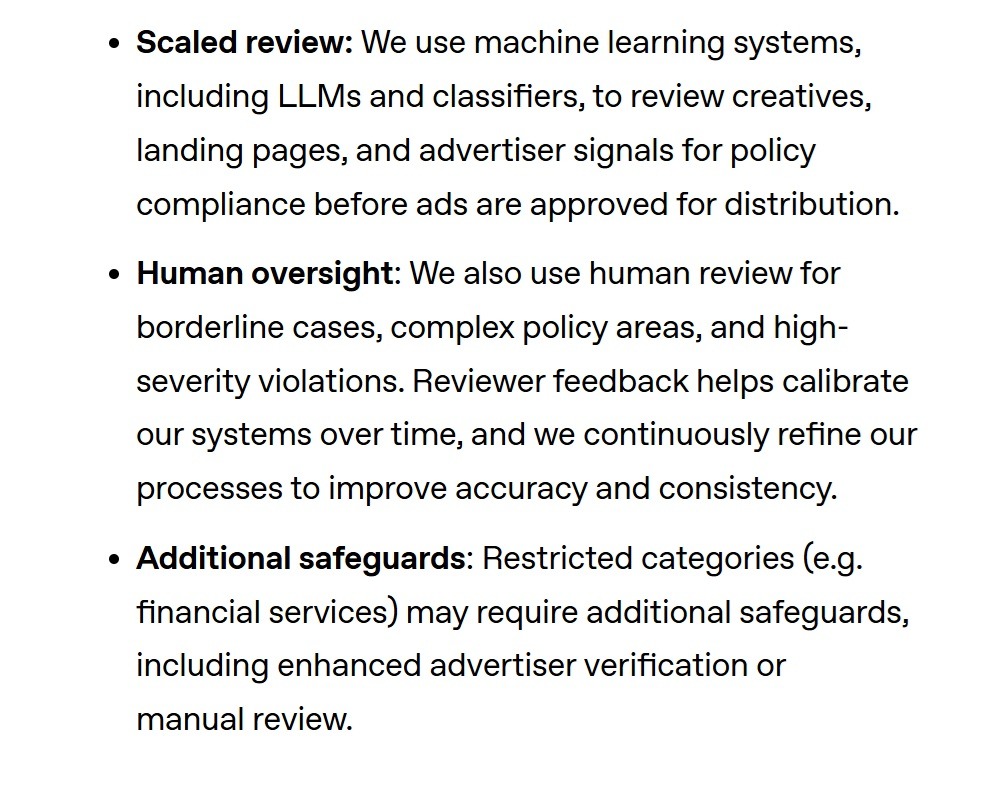
As OpenAI scales up its ad revenue and introduces more ways to incorporate sponsored content, the problem will grow.
Even now, OpenAI warns users to be careful of fraudulent advertisements that might slip through.
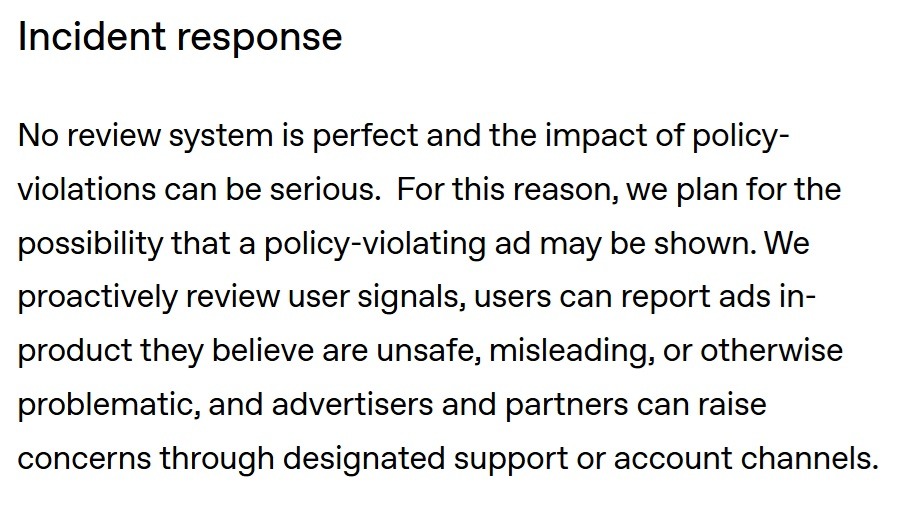
It’s safe to say that you should treat ads in ChatGPT exactly the way you should treat ads in Google: as potential threats.
The Scam Ad Landscape (Big Tech vs. OpenAI)
| Platform | Ad Rollout Tier | Moderation Method | Scam Ad Persistence Rate | Data Sharing Leeway |
| Free / Ad-supported | AI-First (Human if flagged) | ~73% remain after being reported | High (Extensive tracking) | |
| Meta | Free / Ad-supported | AI-First (Human if flagged) | ~73% remain after being reported | High (Extensive tracking) |
| TikTok | Free / Ad-supported | AI-First (Human if flagged) | ~73% remain after being reported | High (Extensive tracking) |
| OpenAI (ChatGPT) | Free & Go Tiers Only | AI-First (LLMs) | TBD (Showing early warnings) | Basic demographics (Open to more later) |
How to stay safe from fraudulent ads in ChatGPT
Ads in ChatGPT will likely become a major attack vector, and it would be naiver to assume they haven’t already. Here’s how to protect yourself:
- Spot the “Sponsored” or “Ad” tags: Always look closely at the layout of your chat results. ChatGPT ads appear as relatively large banners at the bottom of organic responses and are marked with a clear “Sponsored” or “Ad” label.
- Treat paid AI links like shady Google ads: Just as scammers buy Google ad space to inject fake storefronts and harvest credentials, they can use ads to target chatbot users.
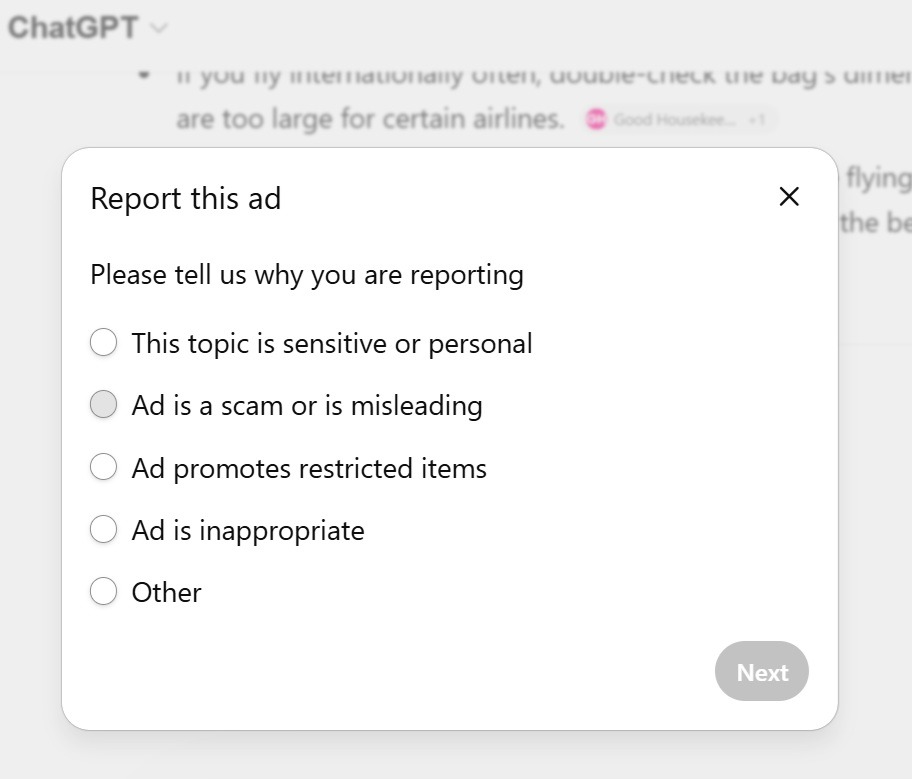
- Report suspicious ads immediately: Click the three dots in the top right corner of the ad banner, select “Report this ad,’ and choose “Ad is a scam or is misleading.”
- Consider upgrading your tier: OpenAI currently only serves ads to users on the Free and lower-cost Go subscription tiers. Higher paid tiers (such as Plus at $20/month) remain completely ad-free.
Ads in ChatGPT FAQs
Read on for more information about ChatGPT ads.
1. Does ChatGPT have ads?
Currently, ChatGPT only has ads on the free and Go tiers. Higher tiers ($20 and above per month) do not have any ads.
2. When will ChatGPT have ads?
ChatGPT began to integrate ads in February of 2026.
As of the time of writing, ChatGPT is still testing its ads. You may not see ads across every chat, and OpenAI has promised to warn paying users if they are selected for ad rollouts.
3. What should I do if I come across a scam ad in ChatGPT?
Report the fraudulent ad. You can do this by clicking the three dots in the top right corner of the ad and selecting “report. Then select “Ad is a scam or misleading” from the list as shown in the image below.
4. What will ChatGPT ads look like?
ChatGPT ads look like a relatively large banner at the bottom of organic results with a “sponsored” tag or “Ad” tag.
5. Do ChatGPT ads misuse personal data?
Right now, OpenAI promises it only shares information about number of clicks and basic demographics with third parties. It has, however, left open the door to sharing more personal information in the future “while still prioritizing privacy” for its users.
ChatGPT uses your past conversations and its “memory” of your previous interactions to personalize ads by default.
6. How do I turn off ad personalization in ChatGPT?
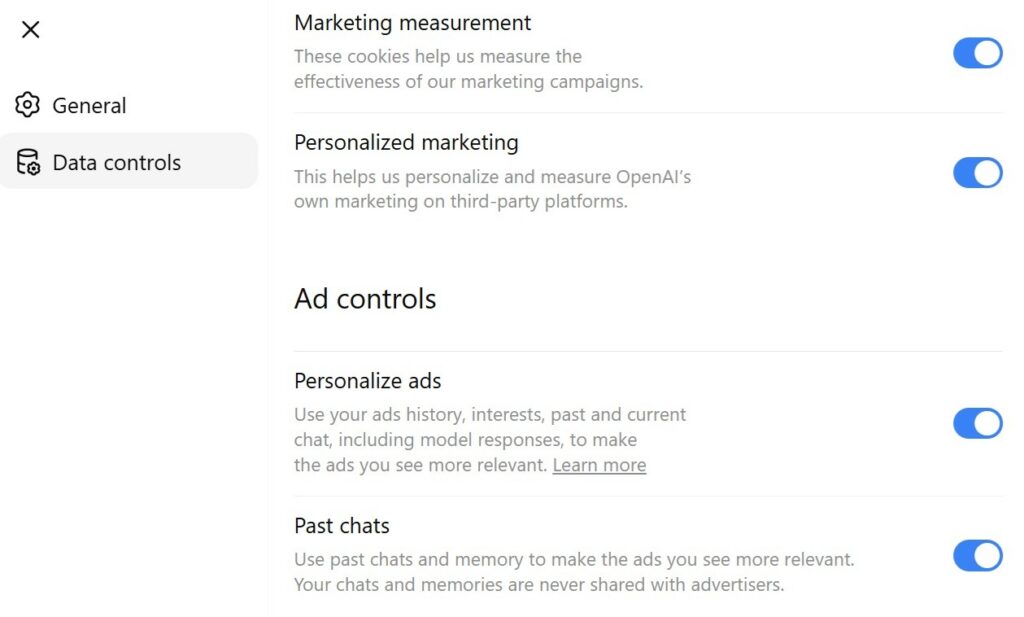
You can disable ad personalization in your settings. If you do this, you will still see ads, but they may be less relevant to you.
Ad personalization is on by default. To disable, click “Settings” in the left sidebar, select “Data Controls,” and scroll down to find “Personalize Ads” and “Past chats.” Toggle both of these settings off.
Learn more:
- Learn about AI privacy settings and how to protect your data
- Read through our most recent piece on ChatGPT shopping scams
- Discover how to remove your personal information from the internet

news?

Don’t have the time?
DeleteMe is our premium privacy service that removes you from more than 750 data brokers like Whitepages, Spokeo, BeenVerified, plus many more.
Save 10% on DeleteMe when you use the code BLOG10.
Related Posts

Why Doesn’t Gen Z Care About Privacy?
The IDScan Breach Investigation and Your Privacy